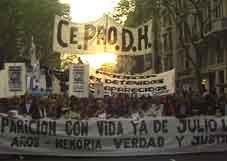
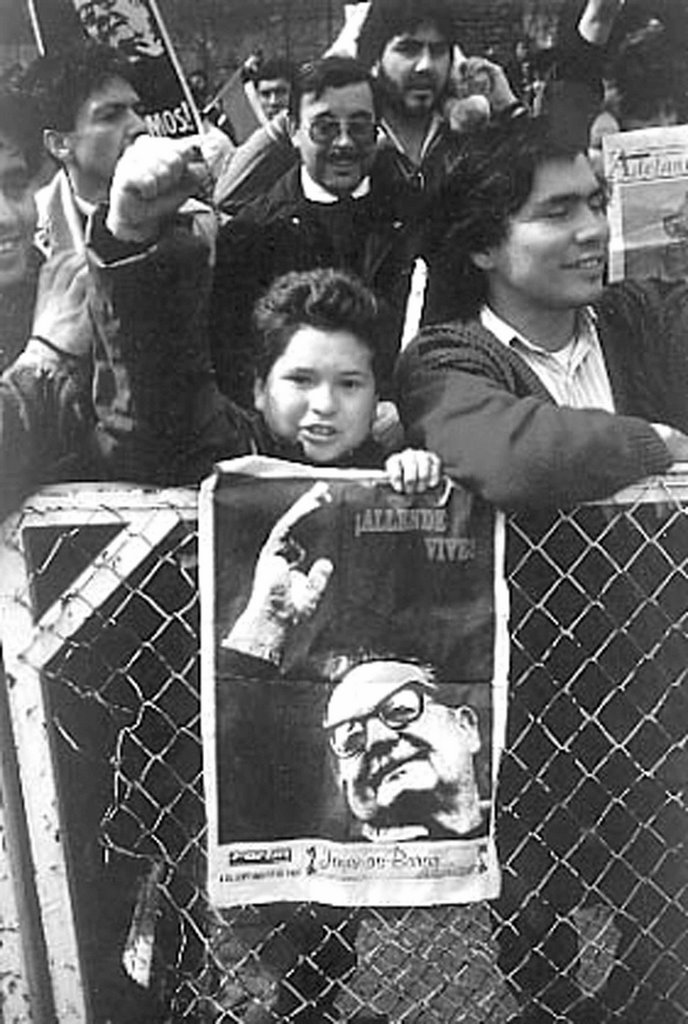
 The news of the death of dictator Pinochet spread fast among circles throughout Latin America. I was in Sao Paulo at a film festival. As we heard the news, fellow political film makers embraced eachother with joy. As the meeting ende
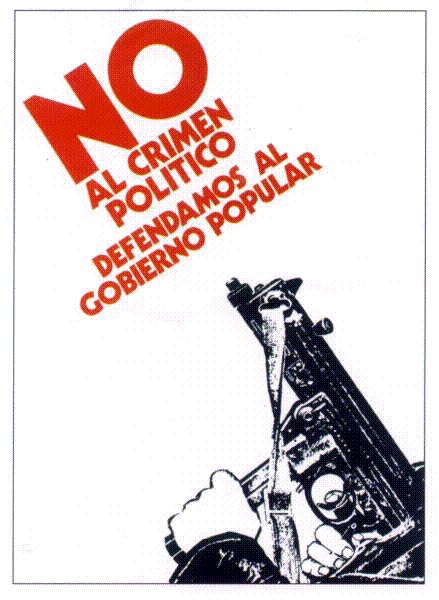 d we brought opened bottles of beer and made a special toast: to the death of a dictator and for freedom. Traces of the dictatorship are alive and well in Chilean society. Currently Michelle Batchelet has ordered police forces to repress any street protests
 that may interfere with the neoliberal order. Many activists have been put in jail in recent days, anarchists and mapuches fighting for self-determination. This short entry is dedicated to the some 4,000 Chileans who lost their lives fighting for a
 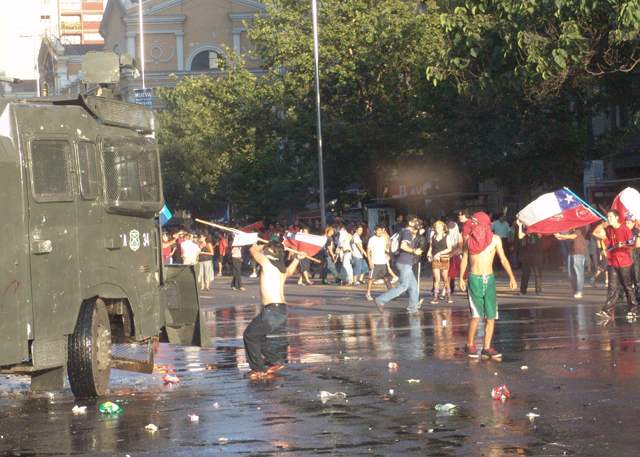 better world.
30 Years Since Chile's Military Coup, Allende Lives
Marie Trigona October 3, 2003Long live Chile! Long live the people! Long live the workers!
These are my last words and I am certain that my sacrifice will not be in vain.
I am certain that at least it will be a moral example
that will punish the felony, cowardice, and treason."
-- Salvador Allende, Sept. 11, 1973
For Latin Americans, Sept. 11 marked a cataclysmic event well before that same date in 2001 was etched in the conscience of the U.S. populace by terror attacks on the Pentagon and World Trade Organization headquarters. On that date in 1973, Chile awoke to a U.S.-supported military coup against its democratically elected socialist president, Salvador Allende. By 12:15 p.m., Allende lay dead in La Moneda, Chile's presidential palace.
To commemorate the thirtieth anniversary of the attack, activists from across the continent gathered in what was more a celebration of the man and his government than a requiem. The International Seminar "At 30 years, Allende lives!" took a close look at the surge of grassroots organizing that grounded Chile's agrarian reforms, as well as struggles for housing and dignified employment during Allende's three years as president. Participants stressed the need for similar popular participation to increase democracy in today's Chile.
U.S. Involvement, End of People's Government
"The armed forces have acted with patriotic inspiration to take a nation out of chaos, a grave chaos that Allende's Marxist government caused," declared a triumphant Gen. Augusto Pinochet Ugarte the night of Sept. 11. Chile's military junta (1973-1990) replaced Allende's democratic socialism with a tyranny of terror that continues to haunt the nation.
Allende's government was targeted as a threat to U.S. strategic policy in Latin America early on. White House tapes reveal that on Sept. 14, 1970, then-President Richard Nixon ordered measures to force the Chilean economy into bankruptcy. "The U.S. will not accept a Marxist government just because of the irresponsibility of the Chilean people," declared Henry Kissinger, Nixon´s secretary of State. "The CIA had a large role in the strike against Salvador Allende and the Chilean people," states U.S. author James Cockroft. "Big corporations like [the] ITT American telecommunications giant also played a large role in preparing the conditions for the coup in Chile. Economic blockades, destabilization of the economy, direct military participation were all part of the imperialist intervention of the CIA and U.S. military," continues Cockroft.
Four U.S. battle ships approached Chile's coast Sept.11, supposedly to participate in regional military practices. They maintained permanent contact with the coup leaders. Leading up to the coup, in July and August right-wing terrorists trained by U.S intelligence agencies carried out over 250 sabotage actions, exploding electric lines, targeting industry belts, and assassinating key civilians. In October 1972 the Chilean Transport Confederation called a general strike, financed by the CIA, which paralyzed the nation. Months before the military coup, the Chilean army began immobilizing worker-controlled factories by organizing operatives and testing the possible reactions of the working class to a coup. "Three years of economic war permitted the White House and internal opposition to win an important sector of the middle class. It's here the official rebels found the base of support to develop their plans," expresses Patricio Guzmán in his moving film The Battle of Chile.
"Economic methods to destabilize progressive governments were perfected in 1973," comments Cockroft. Even while confronting attempts at destabilization, Allende's approval among public opinion rose. On Sept. 4, 1970 Allende, as candidate of the Popular Unity Front, was elected with 36.4% of votes. In March of 1973, Allende's party won legislative elections with 43. 4%. In response to employer lock-outs in industry, factories were nationalized and workers organized themselves to control production. Activists from MIR, the Leftist Revolutionary Movement, tell of expropriating buses with pistols in hand and working armed inside factories to guarantee that production and transportation continued.
Workers, peasants, students, and state workers rallied behind Allende in huge street demonstrations, by organizing community deposit centers where food was sold at cost, and by opening supermarkets closed during the business shut-down. On Sept. 4, 1973, in response to the perceived immanence of the coup attempt and a plebiscite planned for Sept. 11, the largest political act in Chile's history was held in Santiago's center, mobilizing tens of thousands of people.
Cockcroft notes that as a result of the coup, the Chilean oligarchy and the U.S. imperialists were able to install a repressive dictatorship and a neoliberal economic regime that left the majority of the people poorer than during Allende's government, when over half the population improved its economic condition. Pinochet immediately applied U.S.-prescribed measures of privatization and elimination of restrictions on the circulation of capital. Conditions favorable to foreign investors, including tax exemptions, and the lowering of environmental and labor standards sought to lure foreign investors.
But the neoliberal model imposed after Allende's fall was only possible through the brutal control of all political dissent, achieved by militarizing society and implementing a state of terror. "After Sept. 11 all military resources were used to repress the Popular Unity Front, with North American compliance and presence," Guzmán narrates. In the ensuing days, sport stadiums were transformed into concentration camps where thousands passed through the hands of the dictatorship's terror and torture; executions and disappearances became commonplace.
Over the next 17 years, Pinochet's dictatorship insured a submissive and dependent economy and a stranglehold on dissent. It is estimated that about 550 enterprises under public-sector control, including most of Chile's largest corporations, were privatized between 1974 and 1990. During the same period, some 3,000 people were officially declared dead or disappeared.
The Past that Lingers
"After 30 years, our history is still an open, bleeding wound," states Cesar Quirós, Chilean human rights activist from the Manuel Rodríguez Movement. He notes that Chile's transition to democracy has been full of contradictions. Until the late 80s Pinochet's regime maintained strong control. On Sept.11, 1980 Pinochet adopted a new Constitution to stay in power and announced a plebiscite for 1988. With civil society pressuring for elections, Pinochet's regime was rejected in the plebiscite. He remained in power until his executive term ended in 1990.
Pinochet and his supporters formed a political party, the Alliance for Chile. The first candidate of the right-wing alliance was Pinochet's former Minister of Finance Hernán Büchi Buc, who ran as an independent supported by the pro-government Independent Democratic Union (UDI, by its Spanish initials). Center-left forces formed a coalition made up of 17 parties to defeat the new right and it succeeded with the election of Christian Democrat Patricio Aylwin, with 55.2% of votes in December 1989. Today, the coalition includes the Christian Democrats and center-left politicians, among them many who supported the coup and participated in the Pinochet dictatorship.
Thirteen years have passed since the end of the dictatorship and the much-heralded "return to democracy," but many of the old systems of repression remain. Even now, people continue to denounce new cases of disappearances. Chile has not been able to solve past crimes and current contradictions that have permanent effects on today's society: Some 1,200 disappeared remain unaccounted for; impunity for war criminals continues to be the legal norm; the same military and police forces control the streets; and ex-military leaders of the dictatorship are serving as senators for life. Nelson Mery, chief of Chile's Investigative Police since 1990, resigned his post on Sept. 26 of this year, more than a month after being formally accused of torturing prisoners during the 1973-1990 dictatorship of Pinochet.
Quirós maintains that due to pressures from the right-wing and U.S. political interests, Chile's return to democracy has brought little fundamental change. "Chile's democracy is still a dictatorship, nearly intact. Constitutional powers are the same, it's the same Constitution of 1980. When you talk about Chile's armed forces, they are the same as under Pinochet. The armed forces continue to claim that they will not allow another popular government like Popular Unity. They've made sure that popular sectors are not able to embark on a new attempt to change this unjust society that excludes the majority and is anti-democratic."
The Chilean Constitution that Pinochet adopted provides the military with autonomy from civil government, allowing armed forces to act unchecked. Referring to the Constitution, current President Ricardo Lagos has stated: "The authoritarian seeds are there intact. Our transition has not been concluded, we don't have a Magna Carta that has democratic norms." Nonetheless, many feel that Lagos' efforts at political reform have been symbolic, while at the same time guaranteeing impunity and amnesty for those responsible for crimes during the dictatorship and dutifully applying neoliberal policies.
"For 30 years, Chile has been a model of imperialism. Now we have both forms, economic and military control. Economic measures today are the same neoliberalism that Pinochet implemented in the 1970s, but it's more ferocious, sophisticated and complete," Cockcroft asserts. He adds that today these policies are being imposed by free trade accords, exemplified by the North American Free Trade Agreement (NAFTA) in the north and the U.S.-Chile Free Trade Agreement in the south.
Although from the same party as Allende, Lagos has been a staunch promoter of the free trade agreement with the United States. In July, the U.S. Congress ratified the free trade Agreement with Chile and the Chilean Congress expects to pass and sign the agreement no later than Oct. 31. The first ratified free trade agreement of this type in South America will then take effect Jan. 1, 2004. The United States is already Chile's primary client for exports, with total sales to the United States at over $2.87 billion. The agreement with Washington will immediately lift 85% of Chile's import taxes and will totally abolish tariffs by 2014. Lagos had already signed a free trade agreement with the European Union in 2002.
Conflicts Unresolved
Chile has adopted a model for development that only benefits a small sector of society, led by transnational businesses, and leaving out most workers and peasants. Nearly 22% of the population is living below the poverty line and the unemployment rate stands at 9.2%. The economy has been globalized through privatizations and is dependent on imported capital and foreign investment. Conditions for macroeconomic policies are set by foreign bodies, especially the U.S. government and the multilateral financial institutions. Like its neighbors Argentina, Brazil, and Uruguay, Chile continues to borrow from financial institutions to stabilize capital flows, while private debt accumulated under the dictatorship has been absorbed by public sectors. In 1980, Chile's debt was $11.2 billion; by 2002 it had swelled to $40.4 billion.
Agrarian reform carried out under the Allende administration has become a thing of the past. On the contrary, tendencies toward concentration of land have grown stronger in recent years, a cause for concern in a nation where nearly 14% of the labor force works in agriculture. Francisca Ramírez, indigenous activist from Vía Campesina, sees the impact of the transnationalization of agriculture on the small farmers she works with every day. "We are demanding that what we produce and eat not be determined by corporations and capital forces. This government's vision is that agriculture has its basis in the free market, that it's necessary to produce for those with money." She reaffirms the need for Chile to be able to sustain its basic needs through developing agricultural diversity and blocking agri-corporations from further extending systems of monoculture.
The past two decades have also seen increasing conflict between Chile's indigenous peoples--particularly the country's largest indigenous group, the Mapuche--and a series of Chilean governments over questions of land rights and development. These conflicts have resulted in a number of deaths. Most recently a 17-year-old Mapuche activist, Edmundo Alex Lemun, died on Nov. 12, 2002, five days after being shot in the head during a clash with carabineros (police) who were trying to forcibly remove a group of Mapuches occupying ancestral indigenous lands claimed by the Mininco lumber company in Angol Province. There are dozens of Mapuche activists today being held as political prisoners in Chile's jails as part of struggles for land rights.
Washington's policy proclaims that the proposed free trade agreements will help usher in "a hemisphere of liberty." Linking free markets to democracy, U.S. President George W. Bush has declared that "people who operate in open economies eventually demand more open societies." The U.S. continues to support governments that adopt favorable conditions to foreign capital and investments, but today it chooses its tactics more carefully. Making back-door trade agreements, setting financial conditions, and controlling the poor through structural adjustment policies of international lending institutions have replaced financing and supporting military dictatorships.
All-Too-Living Legacy
On Sept. 11, while Lagos attended ceremonies in front of La Moneda to commemorate those who lost their lives 30 years ago, Pinochet attended a different ceremony. Twisting history to celebrate himself as a legitimate statesman, Pinochet commemorated 30 years since the military coup and donated his presidential sash to the Pinochet Foundation. This foundation's objective is to honor the dictatorship. Some 4,000 people attended this ceremony. In a symbolic act, current head of the Chilean military Gen. Juan Emilio Cheyre, made a surprise visit to Pinochet's home to chat with the ex-dictator--who was Cheyre's commander-in-chief in 1973. Neither made any public declaration of what they talked about in the meeting. Cheyre also attended ceremonies at the Military School to commemorate the deaths of anti-Allende forces during and after the military coup. In national newspaper headlines he was quoted as saying, "I feel secure about our power to manifest that the Chilean Army has carried out its tradition of military honor."
Jorge Martínez Busch, former military commander-in-chief and current senator, also publicly defended the military coup. In one of the ceremonies he stated that the military should "wake up and take action," referring to the military's power to guarantee immunity for crimes against humanity.
On Sept. 9, family members of the disappeared and ex-detainees peacefully occupied the Mexican, Portuguese, and Swiss embassies to demand an end to impunity for military criminals. "We have organized this action, because at 30 years since the military coup that ended Salvador Allende's constitutional government, the state has not sought justice for crimes against humanity, or executions perpetrated by the Armed Forces and agencies created to repress a defenseless population," stated a woman participating in the action. "In 13 years the government of conciliation has not reached truth and justice with respect to the atrocities committed by the dictatorship. There are more than 200 ex-military personnel exempt from judicial process, including Pinochet. Also exempt from justice are many civilians who investigated, collaborated, covered-up, or participated directly in repressive acts."
Days after the military coup, songwriter Victor Jara was detained, tortured, mutilated, and executed inside Chile's National Stadium. His body--badly beaten, with 44 bullet wounds and wrists broken by rifle butts--was found days later in an abandoned field. Thirteen years after Chile's transition to democracy, Lagos agreed to officially rename the stadium after Jara on Sept. 12. This symbolic gesture marks years of struggle by organizations and activists, but it also marks the contradictions between today's democracy and a system of terror still intact. The night of Sept. 11, hundreds participated in a march to the stadium to realize an act of homage to Victor Jara. As in like cases of so-called "unauthorized" marches, Chile's police force was ordered to repress. Demonstrators were tear-gassed, water-cannoned, and beaten. Four hundred arrived at the stadium, where thousands of candles were lit to give homage to those revolutionaries who died. Outside, hundreds more gathered after marching down the Alameda where they confronted the police.
During what the newspapers called "the night of terror," some 200,000 people in the working class neighborhoods outside of Santiago suffered a blackout when electricity lines were cut. Neighborhoods themselves cut the electricity to make it harder for the police to repress demonstrators. The worst battles between police and demonstrators were fought in these working class neighborhoods. After it was all over, police chief Alberto Cienfuegos sent a radio message congratulating the police for their work "with so much passion and energy." Twelve police officers were wounded in the actions, one shot in the face. There were some 300 demonstrators detained.
History, memory, and personal experiences have not let the events of Chile's past 30 years be erased. Activities and actions commemorating Allende demonstrate that thousands of Chile's workers, peasants, and students have not abandoned what is known as the "Battle of Chile." Chilean organizations and social movements continue to demand justice for the disappeared, an end to impunity, and a real democracy.
"I was here during Allende's government. I learned a lot from the Chilean people. It's important for the world to understand who this hero was. The other lesson to learn is that this president didn't prepare the people for such an attack, an attack so voracious. Many in the government knew that the coup was very probable. It's hard to say this publicly, but we recognize that we need to prepare ourselves to defend ourselves. Prepare ourselves against a military intervention," James Cockroft warned at the 30-year anniversary.



 Women from across Argentina gathered in the northwestern province of Jujuy for the 21st National Women's Congress on the 14th and 15th of October. During the workshops and rallies at this year's congress, the central outcry was for women to claim self-determination over their bodies and sexuality in Argentina's highly sexist and religious society. In recent years there has been a surge in women's groups organized autonomously from the government, political parties and institutes.
  Liliana Pomilo, from a non-governmental organization which works on educational initiatives for poor women in Cordoba, says that the congress has served to build a women's movement capable of making strides in gender equality. "For more than 15 years I've participated in these congresses. This is an unprecedented experience: women from diverse ideologies, beliefs and organizations gathering together and working on shared issues surrounding what we do in our daily lives. This is what this gathering is for, for us to inform each other about what is occurring in each of our regions. We decided last year in Mar del Plata to hold this year's congress in Jujuy, because this is homeland of Romina Tejerina who is in jail because abortion is illegal."
 Though abortion is illegal in Argentina, it is estimated that 500,000 pregnancies are terminated every year through clandestine abortions, which have become the leading cause of maternal mortality in the country. Abortion is only legally permitted in cases of rape when the woman is deemed mentally disturbed or retarded, or when the health or life of the expectant mother is endangered. Religious groups like Opus Die, an ultra-conservative Catholic organization that supported the 1976-1983 military dictatorship, stopped two mentally ill women who were raped from terminating their pregnancies through court actions in July this year.
  "The objective in this congress is for us to meet [other] women and share our experiences. Lesbians in Argentina have never held a national gathering," says García. "The only place where the lesbians in the country have had the chance to meet has been the national women's congresses and the congresses have been very important for lesbians organizing. One of the first issues that come to surface is visibility. Lesbians are hidden."
 Many women are working to open social discussion of gender and sexuality in general. Corina Nunez forms part of a group that facilitates gender workshops for women in working class neighborhoods in Buenos Aires's suburban belt. She participated in a workshop on sexuality to strategize how to open discussions on gender issues in barrios where machismo is the norm. "We are working with women so that we can end the idea that sexuality is something taboo, secret or something that only women from the bourgeoisie can enjoy. Sexuality is part of who we are; we are sexual beings. Sex education needs to be part of society. Abortion should be free and accessible in all hospitals. All women should have access to free birth control and condoms."
 However, discussions weren't limited to reproductive rights. Many women have become leading protagonists in working class struggles. Public hospital workers, school teachers and factory workers joined together in workshops to discuss strategies for women organizing in the work place and in unions. Women have had to re-organize their households and lives to cope with falling salaries and increasing inflation.
  The women at Zanon created a Women's Commission (Comision de Mujeres de Zanon ) nearly a year ago after a national congress on gender and equality in the Coastal city of Mar del Plata. They have begun to print a newsletter, which is distributed to all 470 workers. The objective of the Women's Commission is for the women at the factory to build their own space to meet and discuss prejudice they must face in a sexist society. Many of the Factories without Bosses (FaSinPat) women have triple roles as working women, mothers and activists, with particular challenges women must face. In Jujuy, Zanon's Women's Comission distributed pamphlets explaining the workers' struggle and specially printed ceramics with the National Women's Congress's logo, which sold like hot cakes.
  Catholic groups are currently organizing a counter protest to occur during this year's upcoming Gay Pride March in Buenos Aires. Ultra-conservative groups have been gaining steam in the past year, especially with the rise in groups rallying for amnesty for military groups accused of human rights abuses, and a return to dictatorship rule. With the wave of threats and attacks against activists, the National Women's Congress has become even more important to prevent further patriarchal attacks against gender equality. Next year's congress is to be held in Cordoba, and organizers have said they will not allow protests from local conservative groups to stop the congress from taking place.