Saturday, September 30, 2006

Democracy’s Disappeared: Argentina Searches for Missing Witness


29 Sep 2006by Marie Trigona for ZNet

znet commetary

Argentina has opened several high profile criminal cases charging former military officers for human rights abuses during the 1976-1983 military dictatorship. For the first time in the nation’s history, an Argentine court sentenced a military officer to life for crimes against humanity earlier this month. As the South American country re-evaluates its dark history, new skeletons in the closet have reappeared.

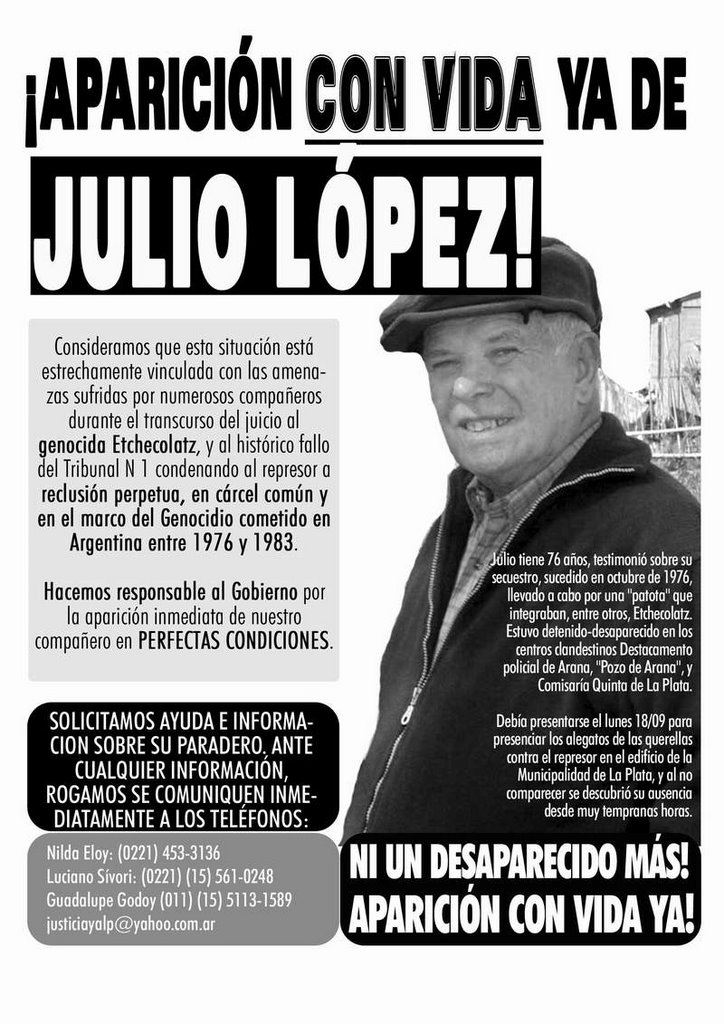
Police are currently searching for a missing 77-year-old witness whose gripping testimony of torture helped convict a former police officer in the first “Dirty War” trial since an amnesty law was overturned. Julio Lopez, a key witness in the trial of a landmark human rights case, went missing on the eve of the September 19 conviction of a former police investigator. Human rights groups are pointing to the provincial police with ties to the 1976-1983 military dictatorship for kidnapping Lopez.

A federal court in Argentina sentenced a former police chief to life in prison for crimes against humanity and for the murder and torture of political dissidents during the 1976-1983 dictatorship. Retired police chief Miguel Etchecolatz, now 77, ran clandestine detention centers in the Buenos Aires province during the military dictatorship. He is the first military officer to be sentenced for crimes against humanity and sentenced to life.

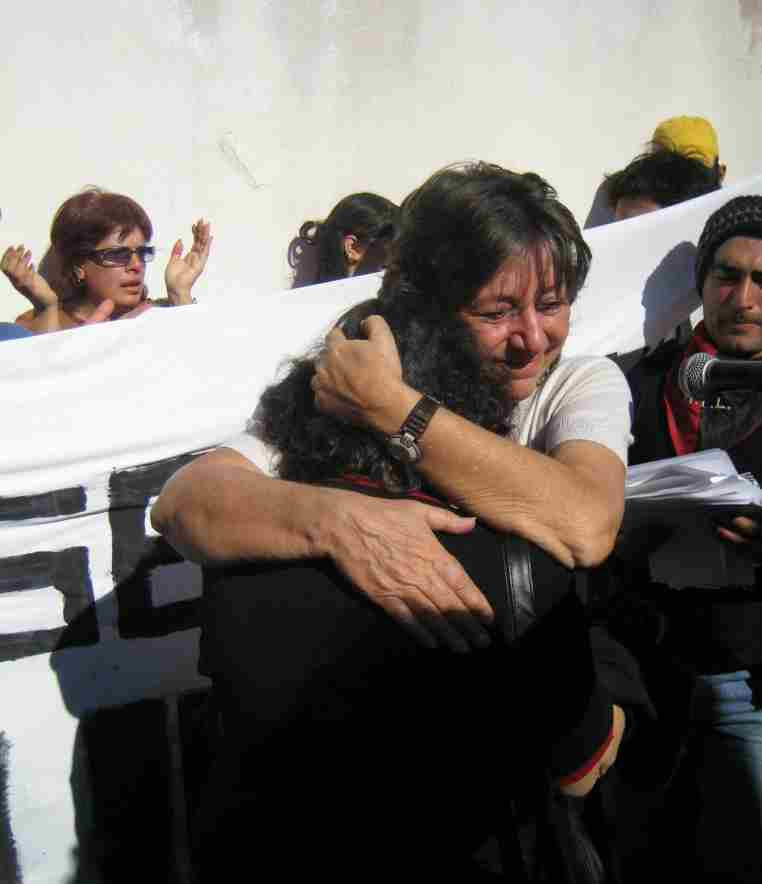
In the courtroom Etchecolatz kissed a crucifix after the sentence was read. Several spectators threw red paint on him and chanted assassin as he was escorted out of the courtroom. Human rights activists and relatives of the disappeared celebrated the verdict while embracing each other inside and outside the court room in La Plata, 40 kilometers from Buenos Aires.

This is the second sentence of a former military officer charged with human rights abuses, after Argentina’s Supreme Court struck down as unconstitutional legal immunity for former officers who served during the era of military dictatorship. He was arrested and sentenced to 23 years in 1986, but was later freed under the full stop and due obedience laws implemented in the early 90’s foreclosed any successful prosecution of ex-military leaders for human right crimes by the courts.

In his testimony, Lopez said that Etchecolatz tortured him during his detention from 1976-1979. He said that Etchecolatz would personally kick detainees until unconscious and oversee torture sessions. Over 100 witnesses testified during the trial, including former president Raul Alfonsin, who defended his decision to pardon military under arrest for human rights abuses. During the 90’s Etchecolatz benefited from state-supported impunity. For the past ten years, Etchecolatz lived in the Buenos Aires province and allegedly has ties to neo-nazi groups in the provincial police force.

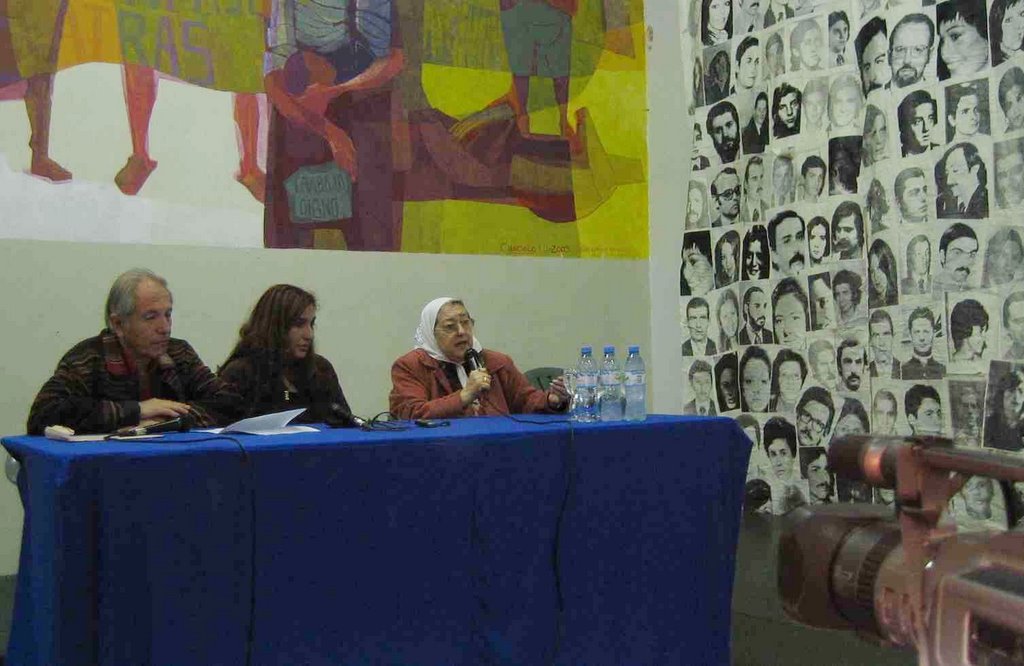
At a press conference, Adriana Calvo who was kidnapped and forced to give birth in a detention center ran by Etchecolatz, said that the disappearance of Julio Lopez is an attempt to scare survivors from carrying out future trials against torturers. “We associate Julio Lopez’s disappearance with the conviction of Etchecolatz for crimes against humanity. We think that Etchecolatz’s bullies still in action kidnapped Lopez for revenge.”

Calvo added that Lopez’s disappearance on the eve of the September 19 conviction could have stopped or delayed the charges against Etchecolatz. The day of Lopez’s disappearance, the legal prosecutors had to present the allegations against Etchecolatz. As a major witness, Lopez needed to be present for the allegations. She also counted any possibility that Lopez had a personal crisis from re-living his testimony of surviving a detention center. “Although, he recently turned 77, Lopez new perfectly well the implications that his presence in court. He was proud of the fact that he had re-activated his activist activities.”

Many of the witnesses have received anonymous threats, including those who testified in the Etchecolatz trial. During the trial, federal police who were there theoretically placed to guard witnesses had to be removed because they were pressuring witnesses inside the courtroom.

According to Enrique Fukman, an ex-detainee at the ESMA Military Mechanics School the largest clandestine detention center in Buenos Aires, police with ties to the military dictatorship want to implement fear to stop the trials against military officers who served during the military dictatorship. “The phone calls are used to create fear. But they couldn’t scare the witnesses off, the witnesses testified which lead to the historic conviction, which the court declared that the military dictatorship carried out a plan of genocide to wipe out dissidents.”

For Margarita Cruz, a torture survivor from the northern province of Tucuman, Julio Lopez’s disappearance is the result of 30 years of injustice. “Intimidating survivors so that these cases remain unopened has happened throughout the country. For survivors Lopez’s disappearance brings back memories of our kidnappings and what we lived through during the military dictatorship. Lopez’s disappearance is the maximum expression of the dictatorship’s traces and impunity for crimes against humanity.”

The Buenos Aires police, infamous for their brutality, have faced recent purges since 1998. However, many of the off-duty police still operate informally and have ties to right-wing groups. In Buenos Aires alone, human rights group COREPPI has registered 1,900 cases of gatillo facíl, young kids gunned down by easy trigger police.

Even the government is worried over the whereabouts of Lopez. Provincial police aided by police dogs are hunting for Lopez. A government sponsored television ad has aired nightly, offering 64,000 dollars in award money for leads on Lopez’s whereabouts. Calvo from the Ex-detainees Association said that money won’t solve the problem and that it is unlikely for police to find Lopez. Buenos Aires governor Felipe Sola admitted that provincial police may be connected to Lopez’s disappearance. Each day that goes by, the likelihood of finding his whereabouts becomes more grim.

During a meeting between human rights groups and Buenos Aires government officials, activists questioned the Buenos Aires Security Minister León Carlos Arslanián whether police officers who served during the dictatorship were still active. He answered, “yes about 70 officers but they were only 20-years-old during the military dictatorship.”

Calvo who was present at the meeting said: “You have no idea how the young officers with only 20-years-of-age tortured us.” Solá retired 60 provincial police who operated in clandestine detention centers on Monday September 26. It’s alarming that officers who operated in the clandestine detention centers and had direct contact with torture victims were working as active officers until this past week.

Fukman says that police today have a clear interest in defending amnesty laws that protect military and police who disappeared and tortured 30,000 people. “The government uses security forces to repress, that’s where the state’s responsibility in the disappearance of Lopez begins. Because the government is saying that it needs the police to repress and its clear that these groups are going to repress to defend their impunity.”

Human rights groups are organizing a series of rallies to demand that Lopez re-appears alive and safe. Lopez’s disappearance and the threats against ex-detainees is a grim reminder of the traces of the military dictatorship. Human rights activists have said that they can’t trust the police forces of today, who continue with the same model left behind by the military junta. “We are convinced that the police aren’t going to find Lopez,” said Calvo. “The only ones who can help to find Lopez are his fellow comrades and the people.”


Marie Trigona is an independent journalist. She can be reached at mtrigona@msn.com. This commentary was originally published on Znet.

Sunday, September 17, 2006

Day Of Pencils Remembered In Argentina


Visit Free Speech Radio News to listen to this story, FSRN http://http://www.fsrn.org/news/20060915_news.html

Argentina marks 30 years Saturday since the military operation known as the Night of the Pencils, when the military kidnapped and disappeared 20 high school students from the city of La Plata as part of a plan to get rid of political dissidents during the 1976-1983 military dictatorship. Witnesses say the students were then taken to a detention and torture facility that has been a site of contention for many years. Human rights groups say that the Buenos Aires Governor wants to prevent human rights organizations from holding a vigil on Saturday for the disappeared at the former clandestine detention center. Marie Trigona reports from Buenos Aires

------------

Seven of the students kidnapped during the Night of the Pencils were taken to the secret detention facility known as Pozo de Banfield, in a southern Buenos Aires suburb 30 kilometers from the capital. Until this past year police used the Pozo de Banfield as a police precinct for homicide cases. For nearly 10 years human rights groups have fought to remove the police from the building. Ex-detainees hoped that no one would be detained again in the Pozo de Banfield’s windowless cement 4 square foot cells in the building’s basement. Human rights groups say the building was simply handed over to new authorities to continue with state-supported repression against the poor. This year, they were successful in their demands to close the Pozo de Banfield facility. The police were ordered to move August 17.

Governor Felipé Solá announced this week he was to hold a government rally at the same time and place that human rights groups had planned the vigil. Adriana Calvo, ex-detainee at the Pozo de Banfield and torture survivor says police were removed from the detention center thanks to the work of human rights activists. She was detained in 1977. During her six years of detention, she witnessed numerous cases of tortures of pregnant women and prisoners.

“Human rights groups for months have been organizing the vigil and rally in front of the former clandestine detention center to mark 30 years since the military kidnapped of 20 high school students from La Plata, a day that is known as Night of the Pencils. Some of those students were seen for the last time at the Pozo de Banfield. The Pozo de Banfield is a symbol of the Night of the Pencils.”

Only one student, Pablo Díaz, from the Night of the Pencils survived to tell the story of his fellow students. At least 200 of Argentina's 30,000 disappeared were murdered at the Pozo de Banfield detention center between 1976-1983. Courts have documented that in the 90’s police from the Greater Buenos Aires district of Lomas de Zamora used excessive force and torture techniques against prisoners at the former detention center.

According to Sergio Smietniansky, lawyer with the human rights group COREPPI, police continued to commit human rights abuses inside the former center after the military dictatorship ended. “The Pozo de Banfield is the synthesis of state terrorism, during the military dictatorship it was used for kidnapping, torturing and disappearing people. During the return to democracy after 1983, it was used to apply the state's repressive policies with easy trigger police and torture. We are proposing the expropriation of the Pozo de Banfield. We want human rights organizations and activist groups to administer the former detention center, the same people who fought for years to close it down. We find out this week that the governor on the same day, time and place decided to hold his own memorial vigil. We think he did this to provoke us. Clearly, the administration is using the Night of the Pencils to gain some legitimacy in human rights.”

Groups want to turn the Pozo de Banfield into a space for memory. They plan to open a cultural and political center. Despite governor Felipé Solá's advise for activists to either participate in the government rally or reschedule, groups are holding a night-long vigil which will conclude with a march around the Pozo de Banfield on Saturday. University students nation-wide are organizing rallies to commemorate students killed in the Night of the Pencils this weekend.

For Free Speech Radio News I'm Marie Trigona.

Saturday, September 02, 2006

Israeli Security Forces Kidnap Argentine Journalist


by Marie Trigona
Listen to this story http://www.fsrn.org/news/20060825_news.html
The Mothers of Plaza de Mayo report that a journalist from their radio station was detained while crossing into Palestinian territory. The journalist detained, Tamara Lalli says the Israeli Embassy in Buenos Aires handed over personal information to the MOSSAD, Israel’s Secret Intelligence Service.

Tamara Lalli works as a radio journalist for AM 530, the Mothers of Plaza de Mayo’s radio station. She was traveling in Israel, Palestine and Lebanon covering the Middle East conflict. While crossing into Gaza, agents from the MOSSAD detained her early Tuesday morning saying she was partial in her radio coverage. Lalli was later deported to Jordan and banned from entering Israel for life.

In a phone interview from Jordan, Lalli says the Israeli Embassy in Buenos Aires has been spying on Argentine citizens. “For six hours I was held by three men who said they were from the Israeli secret intelligence service. A fourth man had a machine gun pointed at my face. For six hours that machine gun was pointed at my face.”

“They asked me all kinds of questions. They know all kind of information, what I do in Argentina, what I manifest, that I mobilize in support of the Palestinian people and that I speak out against Israel on the Radio. They didn’t tell me this from the beginning, they told me this at the very end. They had been informed through the Israeli embassy in Buenos Aires what we do in Argentina. The Israeli Embassy is spying on Argentine citizens. A foreign country spying Argentine citizens in our own country is a violation of civil rights. ”

Lalli is scheduled to return to Buenos Aires next week and hold a press conference. The Mothers of Plaza de Mayo say they are concerned over Israel’s censorship policies.

According to Lalli, the Israeli security forces used methods of psychological torture during her detention. “After that they made me go to another office and strip naked. An official came in stands next to me, while I’m naked with a machine gun in his hand. After being there for six hours the official says to me: ‘look we are not the intelligence service from Paraguay, Uruguay or South America, we are the Israeli intelligence service. We know everything you do from our informants at the embassy. I asked what that means. You work at a radio and speak against Israel, he says. But I said, I want to go to my land, you are violating my right to free speech. He said to me: ‘Here there’s no free speech, there’s security.’”

The Israeli embassy has issued public statements criticizing the Mothers of Plaza de Mayo for their support of Palestinian sovereignty.

Carlos Aznarez, who directs Resumen Latinoamericano, a radio show Lalli reports for, says that Israeli constituents have tried to censor Argentina’s media coverage of the war in Lebanon and Palestine. “Tamara was detained precisely because she is a journalist who follows through with her mission and doesn’t sell her self to Zionism in this conflict. She has always tried to give us information that is the truth about the atrocities of Zionism.”

“Her detention means that the Israeli embassy has more weight than Argentina’s foreign ministry. It means that Argentina’s sovereignty is violated by trying to stop an Argentine citizen from entering Palestinian territory. It means that there is a need to commit hostile acts against anyone who wants to inform what is really happening, about the acts of blood being carried out by Zionism right now in Lebanon.”

The Latin American Journalist Federation and Argentina’s journalists union have issued statements against Lalli’s detention and deportation. Lalli and the Mothers of Plaza de Mayo are taking the case to the courts with charges that the Israeli Embassy violated Argentine citizens’ right to privacy and sovereignty.

Wednesday, August 16, 2006

Wichí fight for land in Chaco


by Marie Trigona
Listen to this story on FSRN
http://www.fsrn.org/news/20060816_news.html

Nine representatives from the Wichí indigenous community complete their 27day on hunger strike in Argentina's north eastern province of Chaco . Fornearly two months hundreds of indigenous people from rural areas have camped out in front of the provincial government building to demand land distribution, education and health care for Chaco 's indigenous communities.

"Our children suffer here at the camp, we are suffering. The rich peoplewith gold say that we're poor off here at the camp, it's true but we'regoing to continue to fight" Eleuterio Gomez, one of the weathered protestors at the camp, says that his community is prepared for hardship after 500 years of colonialism.

Dozens of improvised tents, clotheslines and pots over campfires scatter the central plaza in Chaco 's capital Resistencia. A group of women prepare fried bread and stew for hundreds of protestors at the 60 day old camp. Food runs shortat every meal and many suffice with hot maté. Chaco , the nation's poorest province is home to 60,000 indigenous from theToba, Mocoví and Wichí communities. The nine on hunger strike and hundreds at the camp demand that Governor Roy Nikisch meet with Wichí delegates toresolve the complaints of improper public land distribution. In the pastdecade, soy farmers and cattle ranchers have bought much of government land that should have gone to indigenous communities and small farmers.

According to Mártires López, from Union Campesina an indigenous organization, Governor Nikisch hasn't respected a law protecting indigenous land. Aborigines have sold their land, which is something terrible. Thousands of hectares have been sold. We're in a bad situation, we don't know how to demand our rights. We have a law, but it's like the law doesn't exist for us. The law says that the government has to delegate land to communities. But they aren't following through. The children are dying of hunger. There's not a minimal level of health for us in Chaco ."

The Wichí suffer from malnutrition and preventable diseases like Chagas andCholera. The protestors are also calling for the resignation of Lorenzo Heffner, a local mayor who they accuse of discriminating against indigenouspeople.

Monica Chalole says that the governor has refused to meet with Wichí delegates for months, leading the hunger strikers to take action. "These communities got tired and said that they were going to do something to change the situation. According to studies 3.9 of government land has been sold to businessmen and politicians. As indigenous people we believe that the national and provincial governments have never seriously considered resolving the issue of the aboriginal people. This is why the indigenous communities are living in horrendous conditions."

The hunger strikers have been locked in a government office with no windows.Despite declining health, the hunger strikers continue with their protest.Wichí have set up a camp in front of Chaco 's central offices in Buenos Aires this week.

Friday, August 11, 2006

Julio Simon trial photos


Argentina’s dictatorship: 30 years fighting for justice


By Marie Trigona
Znet commentary
August 11, 2006
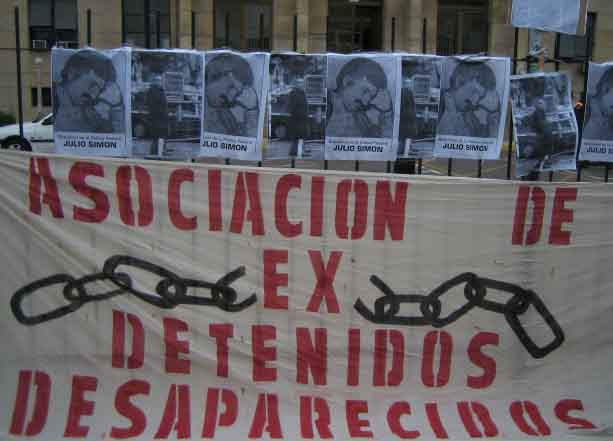
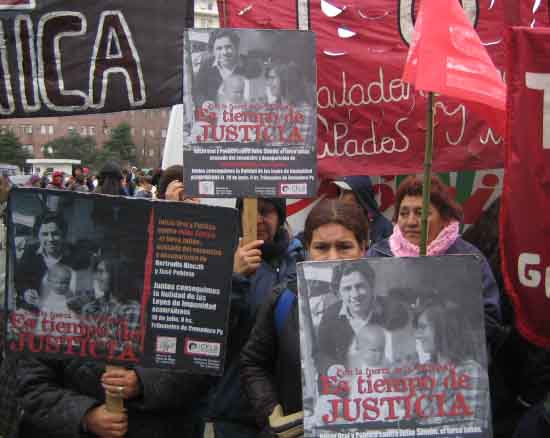
A federal court in Argentina sentenced former police chief Julio Simon to 25 years in jail for the forced disappearances and torture of dissidents during the 1976-1983 dictatorship. This is the first sentence against a former government agent for human rights violations since 2005 when the supreme court struck down amnesty laws protecting former officers who served during the era of military dictatorship. Julio Simon, alias the "Turco" was charged with the forced disappearances of José Poblete and Gertrudis Hlaczik in 1978. The court also charged him of stealing the couple’s eight month old baby.

Some 30,000 activists were kidnapped and murdered during the military junta dictatorship, which ruled Argentina from 1976-1983. During the Dirty War in Argentina, much of the population remained silent due to censorship imposed by the military government. After the dictatorship ended, ex-detainees and human rights groups gathered extensive information to prosecute officers who served during the military dictatorship. However, the full stop and due obedience laws implemented in the early 90's foreclosed any successful prosecution of ex military leaders for human rights crimes by the courts. For over 20 years, victims and their families have waited for due justice.

Last year the Supreme Court overturned the amnesty laws that protected former military officers who served during the dictatorship. Courts have opened several high-profile cases of officials to be tried for crimes during the 1976-83 dictatorship. However, thousands of cases have remained unopened. To date only 160 ex-military personnel have been tried and sentenced for human rights violations. The military ran some 375 clandestine detention and torture centers throughout the country. The 160 who have been tried does not account for ½ a person for each detention center. The terror inside the camps were committed by thousands of military who today benefit 20 years of impunity and freedom.

Over a dozen ex-detainees testified during the trial that Simon had tortured them in the Olimpo, one of the most infamous clandestine detention and torture centers in Buenos Aires. He also carried out dirty work in Club Atletico and El Banco. Many testified that Simon was in charge of welcoming detainees. Susana Caride, torture survivor testified that when she arrived Simon, "beat me with his fists, chains and then threw salt water on me."

The methods of torture used in the 375 clandestine detention centers were a systematic plan to terrorize victims and society. These methods were taught through manuals provided by the US government in places like the School of the Americas. Graciela Trotta testified that Simon made a group of nude men at El Olimpo form a pyramid, a method of torture used in US prisons in Iraq 30 years later.

Rebeca Sacolasky, who is now 83-years-old testified in the trial. She is an ex-detainee and torture survivor. "I was tortured by this sinister character. Now I’m satisfied because he won’t be released for 25 years. I would have liked for the judge to give him a higher sentence, because Simon has a violent heart. He tortured many of us until some of the comrades died." For Sacolasky, her revenge has been continuing to fight for human rights. "I’ve come into contact with Simon several times. It didn’t fill me with rage, it filled me with the strength to continue to fight. I was able to become a human rights activist."

During the trial, Simon refused to testify. The only explanation that Simon gave was during a televised interview in 2000, which was used in the courtroom. "The general criteria was to kill everyone," he said this when he thought the era of impunity was never ending.

JULIO SIMON’S IMPUNITY and ESCRACHE POPULAR
Nora Cortiñas, one of the founders of the Mothers of the Plaza de Mayo, said that the same leaders responsible for illegally detaining, torturing, and killing 30,000 activists during the military junta dictatorship from 1976-1983 benefited from state-sponsored impunity for over 30 years.. "Julio Simon formed part of the groups that tortured detainees. They thought that they would never be punished. They never hid their faces or identity because they wanted the prisoners to see them, thinking that justice would never be applied to them."

After the military dictatorship, Simon settled down in the Buenos Aires’s downtown area of Congreso. He had been on trial, but the Full Stop and Due Obedience laws cleared him of any possible charges. During the 90's he ran a prostitution ring in Congreso, sending women to attend clients from a corner café just a few blocks from national congress.

In the mid-90's an activist recognized Simon, while he was sitting in a café. For weeks, human rights organizers led their own investigation, following Simon’s activities. In 1996, the group H.I.J.O.S. (Children for Identity, Justice and Against Forget and Silence) formed using the escrache as a tool for popular justice and against impunity. Eduardo Nasban, member of H.I.J.O.S. whose parents were disappeared during the dictatorship said that one of the first escraches H.I.J.O.S. organized was against Simon. "The escrache emerged 10 years ago in the search for justice. We began by bringing together organizations and groups of neighbors to show that impunity isn’t an abstraction. It’s something concrete that has a name and address. One of the first escraches organized was against Turco Julian."

Just a few years ago, Simon re-appeared with impunity. During a protest near Congreso several activists recognized Simon sitting in a café. They were surprised, but ready to take action. Simon got a taste of popular justice. They entered the café and beat him up, giving him a few cracks on the head.

JUSTICE and TRUTH
Human rights activists and relatives of the disappeared cheered and embraced each other after the verdict was read on August fourth. Human rights groups have said that this trial was made possible thanks to activists, not government officials. "These cases have been opened after 30 years thanks to popular struggle. But in this trial, the court hasn’t charged Julio Simon with genocide or crimes against humanity, but as if they committed a regular crime," said Leopoldo Tiseira, member of H.I.J.O.S. and whose mother and father were disappeared.

After twenty years, the courts still haven’t located the majority of the mass graves or remains of the disappeared. Human rights groups H.I.J.O.S. and Grandmothers of the Plaza de Mayo have worked for over 10 years to find the whereabouts of the estimated 500 babies born while their mothers were in illegal captivity. Thanks to the work of H.I.J.O.S. they have recuperated the identity of 82 sons and daughters. Right groups have continued to demand that the government release documents from the military dictatorship to locate the children and remains of the disappeared. "The relatives and human rights organizations have always been the ones who led the investigations against the torturers and repressors. The state has opened the possibility to put them (alleged repressors and torturers) on trial, but the government doesn’t have the policy of opening investigations," said Tiseira.

On the opening day of the trial, the Mothers of Plaza de Mayo were banned from entering the courtroom wearing their white head scarves, symbolizing the diapers of their missing children. The mothers left the courtroom, saying that they will not negotiate their head scarves.

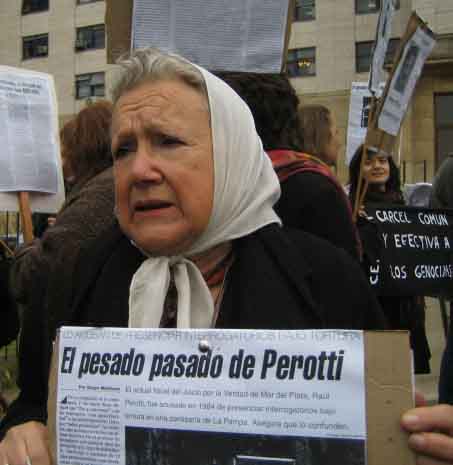
The Mothers of Plaza de Mayo and CELS-Center for Legal and Social Studies, later reported that the federal prosecutor handling the trial, Raul Perotti has been accused of participating in torture sessions at a clandestine detention center in the province of La Pampa, where he worked at the time. According to Adriana Calvo, who was kidnapped, forced to give birth in a detention center and had her baby taken from her, Perotti’s defense marks another roadblock to justice. "It’s terrible that 30 years after the coup we find that the prosecutor who represents the state was an accomplice of the dictatorship’s genocide. The courts are filled with accomplices and it shows us the difficulty that we are going to have bringing cases against those responsible for forced disappearances."

Calvo expressed hope for the future "We are going to continue to work until those responsible for the death of 30,000 go to jail. But what we want is for them to be tried for what they really are, actors in genocide, and not for particular charges. In Argentina the military disappeared 30,000 people, we can’t hold a trial for each of the disappeared. We want those responsible to be tried for the plan the military orchestrated to destroy the majority of the population."

Saturday, July 29, 2006

Mercosur: More Than a Trade Pact

Wednesday, Jul 26, 2006
By: Marie Trigona - Venezuelanalysis.com

Cordoba, Argentina, July 25, 2006—The South American trade pact Mercosur concluded its summit in Cordoba, Argentina on Friday with eight presidents agreeing to work toward regional integration to offset U.S. influence. Venezuela’s Hugo Chavez dominated the spotlight with the oil-rich nation making its formal entry into Mercosur during the summit, boosting the regional trade bloc composed of Argentina, Brazil, Paraguay and Uruguay. Fidel Castro made a surprise visit to Cordoba for the regional meeting, signing several trade agreements and encouraging his left-leaning sympathizers to fight against US hegemony.

The Mercosur bloc was established by the heads of state of Argentina, Brazil, Paraguay and Uruguay in 1991. For many years the trade pact was described by analysts as a novice attempt of a South American version of the European Union. More than 15 years later, the Mercosur trade pact is beginning to emerge as a key economic force with the continent’s No. 1 economy (Brazil) and second largest economy (Argentina) now joined by the third-largest economy (Venezuela). The bloc’s cumulative gross domestic product (GDP) ranks it as one of the world’s largest economies.

Regional integration was a key issue discussed at the summit. Presidents committed to join together to fight against unemployment and lack of access to education and health. The leaders made major headway with trade agreements, natural resource accords and committing to build a new regional bank. Associate members Evo Morales from Bolivia and Michelle Bachelet from Chile attended the meeting as associate members, focusing on gas prices and trade. Even though some conflicts came up during the summit, the central meeting was filled with optimism and inside jokes.

Venezuela’s entry
Argentina’s president, Nestor Kirchner said that Venezuela’s entry into Mercosur was “a historic moment.” Many expect Venezuela’s entry to boost Mercosur economically with the nation’s oil reserves and politically with Chavez’s criticisms of the U.S. In a poll published in the national daily, Pagina 12, seven out of 10 Argentines polled think that Venezuela’s entry into Mercosur is a positive step. However, Brazil, which currently holds Mercosur’s presidential seat, seems uneasy over the possibility of Venezuela taking over Mercosur’s leadership.

Chavez made several key proposals during the meeting, promising oil reserves for the Mercosur trade bloc for the next 30 years. Venezuela, Argentina and Uruguay signed an accord for Enarsa (Argentina’s dormant state oil company) and Uruguay’s Ancap to begin oil explorations in Venezuela’s Cuenca del Orinoco region.

FTAA’s death
Leaders from Argentina, Brazil, Uruguay, and Paraguay followed Chavez’s lead with criticisms of the impact of Free Trade agreements on the third world. Carlos Aznarez, political analyst and editor of Resumen Latinoamericano, said that the regional meeting marked the revival of Mercosur. “With Venezuela’s entry and the possible entry of Bolivia, something which is immanent, the goal of revitalizing an organization that had been inactive has been achieved. For an organization that was dead, it’s a step forward. Venezuela’s entry gave Mercosur an ideological spin, incorporating a courageous discourse to confront Pro-Free Trade policies coming from Washington.”

Nearly 40,000 people attended the parallel people’s summit to hear Hugo Chavez and Fidel Castro speak. During his address, Chavez said that the Free Trade Area of the America’s, a U.S.-backed proposal blocked by the Mercosur nations last year, was dead. “10 years have gone by and we have followed the road toward crucial changes. In 1994 almost every Latin American government had to answer to the US empire. By January 1, 2005 the Free Trade Agreement of the Americas should have already been installed throughout the entire continent. Today we can say we destroyed the FTAA and a new Mercosur has been born, a new Mercosur has been built.”

Mercosur leaders openly rejected the FTAA during last November’s Summit of the Americas meeting of regional heads-of-state in Argentina’s coastal city of Mar del Plata. Surprising even U.S. President George Bush, who hoped to push through free trade accords throughout the Southern Cone. In his speech, Chavez referred to that historic summit. Chavez reminded the audience that during previous summits, Venezuela and Cuba represented the only challenge to U.S. free trade policies. “At one of those summits, Fidel passed me a piece of paper with the message ‘Chavez, I feel like I’m not the only devil at these meetings.”

Mercosur’s agenda for integration
According to Aznarez, Mercosur’s revival has many implications for the people of the Southern Cone. “What does this mean for the people of Latin America in the short term? The extension of regional economic alliances, in different industries such as pharmaceutics and energy resources. In the mid-term, the possibility of building a regional gas pipeline that Venezuela proposed.”

Mercosur’s new full-fledged member also proposed the long term project of building an international oil pipeline that will run from Venezuela to Paraguay, Brazil, Uruguay and Argentina. Securing energy sources has been one of Mercosur’s primary objectives.

During the Mercosur summit, Venezuela also proposed to build a new regional bank for nations frustrated with conditions imposed by the International Monetary Fund (IMF). Argentina, Brazil and Venezuela have already committed 70 million dollars in reserves to get the bank up and running. The regional financial institution will finance infrastructure projects and business investments in those countries at a low interest rate. The bank may function as an alternative to structural adjustment policies imposed by the IMF, which are used as a yardstick to qualify for loans from the IMF and other multinational lending institutions.

The Mercosur leaders also discussed the possibility of reaching a unified stance for the upcoming IMF meeting in Singapore. The economy ministers from Mercosur are working on joint proposals to improve their countries’ standing in the IMF that they will present in September at the lender’s annual meeting.

Tensions
Papermills – Uruguay brought up the dispute with Argentina over the proposal to build a paper mill near the border of the two countries. Argentina’s Kirchner had avoided the pulp mill row during the summit. Taberé Vázquez addressed his Argentine counterpart during his Mercosur presentation. He said that “Uruguay is open to negotiations and is worried about the health of Argentines.” The paper mills project has strained diplomatic relations between Uruguay and Argentina, historically friendly neighbors.

This is the first time Vázquez has addressed the issue since the UN's highest court rejected Argentina's request for an order to immediately halt the construction of the plants earlier this month. Argentina had wanted the World Court to temporarily halt construction of the mills on the shared river, while it weighed its claim that the mills violated a bilateral treaty, which states both countries must consent to all issues that could affect the water of the shared river body. Hundreds from the Argentine town of Gualeguaychu attended the summit in Cordoba to confront Vázquez and to pressure the Mercosur leaders to stop the construction of the plants.

Trade pact with Israel – Mercosur leaders were expected to sign trade accords with Cuba, Pakistan, and Israel. Human rights organizations and Islamic groups in Argentina had requested that the nations suspend the trade negotiations with Israel until Israel suspends attacks against civilians in Lebanon. The Mercosur nations refused to sign the accord and signed an official document calling for a cease fire and end to the attack against Lebanon.

Social agenda for Mercosur
Fidel Castro surprised Mercosur’s left leaning members with his arrival on Thursday. Chavez had invited the island President to participate in the summit. Castro, who will soon turn 80, addressed the people’s summit for nearly three hours in his trade mark green fatigues, urging for social pacts among Latin American nations.

“Today trade between Mercosur and Cuba is at 500 million dollars in imported goods from Mercosur and we export 50 million dollars. We have a tremendous amount of possibilities in our hands. Today in the meeting we talked about Mercosur’s economy. And Mercosur’s social agenda? Don’t forget that word! Mercosur’s social aspects, what that means and what can be accomplished”

The historic revolutionary figure also reminded Mercosur leaders that they mustn’t forget social and humanitarian agenda’s toward building a new Latin America. “We can build a new education program throughout Latin America. In three years we can eradicate illiteracy. We have to believe it to achieve it.” The Cuban leader focused on education and health, applauding Venezuela and Bolivia for the recent initiatives in health and education. “Let’s not forget about globalization. We should globalize solidarity.” Both Cuba and Venezuela have exported their socialism to many parts of the Third World. For many years, Cuba has trained hundreds of doctors and provided specialized surgery for many fellow Latin Americans.

Cuba, a nation with a limited economy, signed several trade accords with the Mercosur nations. Juan Mignetti, professor of political economy at the Mothers of Plaza de Mayo’s popular university, said that Cuba’s participation was a step forward toward globalizing solidarity. “Politically, Mercosur is very important for Latin America. The possibility that Latin American markets integrate and include Cuba means a lot because regional economies will help to break the blockade against Cuba.”

Washington’s silence
Washington’s State Department remained silent over last week’s Mercosur summit. Some Republicans and Democrats agreed that the Mercosur presidential summit was a political meeting, not a meeting leading to trade consolidation and economic pacts.

Aznarez mentioned that the new regional alliance means an end to isolation. “For the U.S., this trio composed of Evo Morales, Hugo Chavez, and Fidel Castro, signifies a true enemy because they are resisting North America’s plans for Latin America. They have rejected the FTAA and the U.S.’s other alternative: individual free trade agreements based on country to country. This regional alliance is going to make those individual accords much more difficult.”

Outcome of Mercosur
Both Chavez and Castro set a strong playing ground for their fellow leaders to follow. The leaders of Argentina, Brazil, Uruguay and Paraguay haven’t been as outspoken in their commitment to social policies as Chavez and Castro. Before Venezuela’s entry, Mercosur’s agenda didn’t include a social agenda. In his address, Castro said Latin American leaders need to make a stronger commitment to social programs. He applauded Chavez and Bolivia’s Morales for how quickly they’ve learned the road to socialism. Without saying anything, he criticized Argentina, Brazil and Uruguay for falling short.

Castro criticized South America’s second largest economy for its high child mortality rate. He also said in his speech that continental governments should commit to humanitarian needs: train more doctors, teachers and university teachers. Argentina has long recovered from its 2001 financial crisis but this recovery hasn’t reached the ranks of the working class.
What remains clear is that Venezuela’s fellow Mercosur leaders are excited about Venezuela’s economic might, but wary of his socialist discourse. With the exception of Castro and Chavez, the Mercosur presidents departed as quickly as they could after the summit. Not a single government official from Nestor Kirchner’s administration attended the parallel people’s summit. Chavez reminded the some 40,000 spectators that the crucial changes in Latin America came thanks to social movements’ resistance to imperialism.

The Mercosur presidential summit marks a clear separation from U.S. imposed economic policies. However, most of the accords set during this summit benefit the major economic groups of the corresponding nations, not the people. Castro hit a strong point when he reminded his admirers that Mercosur should include a social agenda.

Zanon: Worker Managed Production, Community and Dignity


Written by Marie Trigona
Thursday, 13 July 2006 Toward Freedom

http://towardfreedom.com/home/content/view/855/
During Argentina's financial meltdown, many unemployed workers occupied their closed factories and forcibly reopened them – under employee control. Four years later, Argentina's economy is well on the road to recovery, and many worker-run factories are seeking permanent legal status. Workers from the Zanon ceramics factory in the Patagonian province of Neuquen held a rally on July 4 to demand the government expropriate their plant and give permanent legal status to FASINPAT (Factory without a boss), their worker cooperative. If there’s no action, it will lose its temporary legal status in October.

As the largest recuperated factory in Argentina, occupied since 2001, Zanon now employs 470 workers. The long term demand at Zanon is for national expropriation under worker control. However, the workers from Zanon have fought a parallel battle in federal court to legally recognize the FaSinPat cooperative. In October 2005, the FaSinPat cooperative won a legal dispute, pressuring federal courts to legally recognize the FaSinPat as a legal entity that has the right to run the cooperative for one year.

FaSinPat’s Legal battle

"The workers built this factory." COMMUNITY "All of us defend the factory." DIGNITY "We’ve put the plant back into production." PRODUCTION "We’ve created more than 250 jobs." WORK "Today, the factory is at the service of the community." SOLIDARITY "Zanon belongs to the people, join us."

As part of the campaign for the definitive expropriation of FASINPAT, Zanon workers produced a television commercial inviting viewers to participate in the march. For the rally, Zanon workers stopped production and brought trucks carrying machinery out into the streets to show senators and the community what the workers have achieved in their factory. The FaSinPat cooperative has presented a legal proposal, backed by 17,000 signatures, requesting the definitive expropriation of the factory.

Alejandro Lopez, a Zanon worker said the cooperative needs a permanent solution after four years of worker control. "Soon in October the cooperative’s legality expires. We don’t want to go back to the old story of eviction threats and put the new jobs we’ve created under worker management at risk. Even with everything we’ve accomplished the provincial and national government hasn’t listened to us. We’re organizing a different kind of rally. We want the senators and community to get to see what worker management looks like. All they see when they drive by on the highway is a factory, but Zanon is much more than a factory."

Production is political

Many workers say the legal status of the cooperative has allowed the cooperative to catch an edge on the market by to getting rid of middlemen. Currently, the FaSinPat cooperative is invoicing all sales, purchases and payments with legal status. In June the plant produced over 400,000 square meters of ceramic tile, a record for the factory since the take over in 2001. "Quality control is the responsibility of all the workers," said the plant’s production coordinator, Francisco Murillo who has worked at Zanon for 15 years. The factory has competed successfully within the domestic market which is growing. The Zanon ceramics plant is one of Latin America’s largest and modern tile factory. While the former owner Luis Zanon exported over 80 percent of the factory’s production, the FaSinPat cooperative has marketed high quality and low price products to markets locally and nationally.

Murillo said that increasing production hasn’t been easy due to the lack of government support and capital investments. "In 4 years of worker management we went from producing 15,000 square meters per month to over 400,000 square meters in a factory that was equipped to produce one million square meters per month. But we’re producing in a factory that was run down due to neglect and lack of maintenance by the former owner." He adds that the Zanon workers have done what bosses aren’t interested in doing: creating jobs and support community projects. "Now that we’ve increased production, improving quality and production output will become easier. Part of the profits are being put towards creating new jobs, improve machinery and replacements for the machines. The other part of profits generated are being put towards society."

Democratic social relations

Under worker control, no management or professional stayed at the factory. The workers not only had to re-learn the process of production but also other traditionally administrative areas like sales, book keeping and production planning.

Carlos Saavedra, a Zanon worker with over 10 years laboring on the glazing sector says that every worker in the plant has equal standing. "For the workers the decisions should be decided by the assembly as the only authority in the factory. It shouldn’t be like the old administrative system with managers, unionists or one delegate who decides what is to be done." At Zanon every worker is paid the same wage, with the exception of a small pay difference based on seniority, but seniority based on who withstood the old boss, firings, stand off and occupation.

The workers at Zanon have developed a coordinator system to organize production and basic functioning. Each production line forms a commission. Each commission votes on a coordinator that rotates regularly. The coordinator of the sector informs on issues, news and conflicts within his or her sector to a assembly of coordinators. The coordinator then reports back to his or her commission news from other sectors. The workers hold weekly assemblies per shift. The factory also holds a general assembly, during which production is halted.

On the day of the rally, the cooperative held its monthly general assembly. The assembly began at 6am, long before dawn during Neuquen’s winter. Some 400 workers huddled into the
factory’s tool and die shop to discuss aspects of worker self-management. The assembly began with an evaluation of the TV commercials produced by Zanon workers developing an audiovisual area. Every month the bookkeeping coordinator gives an extensive report on the income and expenditures at the plant. During the assemblies workers decide how profits should be used. This month, the assembly voted on a pay bonus workers went beyond the production quota goal for June. Workers also voted in favor of hiring 15 new workers. Who will get the job is decided on a criteria based on family needs, political commitment to the struggle and technical experience. One participant also brought up the possibility of workers rotating to explore other areas of worker management.

The assembly concluded with the political aspects of "gestión obrera" (worker management). Zanon invited representatives from a wide range of labor conflicts nationwide. Zanon workers have remained true to their roots by building a network of mutual support with other worker conflicts and recuperated enterprises. Mercedes Mendez, a nurse from Garrahan, Argentina’s largest public children’s hospital spoke during the assembly and address the importance worker self-management has for Argentina’s workers. "It’s very moving to visit the factory. You have worked so that the entire working class feels that Zanon belongs to them. We hope you win the expropriation of the plant so that the factory can remain at the service of the community."

Producing for the community

Besides producing ceramics the factory has committed itself to projects like donating ceramics to community centers, building homes for working class families, hosting student field trips and printing ceramic alphabets for schools. During an interview with Omar VillaBlanca, we were interrupted by a phone call from a public school teacher coordinating a visit to the factory. "One of our slogans is that we have opened our doors to the community. We bring the school children to visit to find out for themselves what a factory in production looks like and so they know they can build another kind of society." In the press office at the factory, the walls are lined with thank you posters hand-made by grade school students. For many students visiting Zanon is a curious and moving experience. VillaBlanca said that the students usually ask a long list of questions. "The first question they ask is, why isn’t there a boss?" The school visits have served as an outreach tool because most of the students talk about their visit with their families at the dinner table.

One of the keys to Zanon’s success has been the insertion of the workers’ struggle into the community. According to VillaBlanca the workers have a lot more at risk than a factory. "First all the jobs are at play, secondly the community work we’ve developed wouldn’t be possible. Also we’d lose an experience developed over five years that has become very valuable for workers nationally and internationally."

The Zanon workers insist that demanding the definitive exploration of the plant isn’t a utopia. Provincial governments have expropriated over 150 businesses abandoned by their owners and taken over by the workers since Argentina’s financial meltdown in 2001. The Zanon workers are planning future rallies and festivals in Buenos Aires before the legality of the FASINPAT cooperative expires.
www.obrerosdezanon.org and http://www.agoratv.org./

Argentina’s soccer passion

by Marie Trigona
Originally published as a Znet commentary June 28, 2006
http://www.zmag.org/sustainers/content/2006-06/28trigona.cfm
The world cup is here. Until July 9th, 32 national teams will play for the Word Cup title. It is estimated that the World cup will draw five billion viewers world wide. Argentina is no exception to the frenzy. South Americans are the wildest about their soccer, with the highest TV ratings. Argentina’s passion for soccer is a cultural mainstay and part of national identity regardless of class backgrounds.

This year’s World cup tournament has brought back a wave of fervor for Argentina’s national soccer team. Argentina is expected to have a good chance at the World Cup title with super stars like Lionel Messi and Carlos Tevez, young soccer magicians leading the offense.

I just returned to Argentina in the height of this year’s World Cup fever. Fans’ passion for the sport has inspired even sports nerds like myself. During the recent matches, the streets of Buenos Aires have looked like a western ghost town with everyone shut in their homes or workplaces watching the game. International and national companies like Pepsi, Quilmes beer, Adidas have featured Messi and Tevez marketing their products. Local stores, bars and citizens have been plastered with Argentina’s national colors, sky blue and white. Every news broadcast (morning, noon, evening and nightly newscasts) feature special reports on the world cup. National politics and local events seem to have been frozen in time until the world cup ends and Argentina takes home the cup. With nothing else seemingly happening in the country, it seems logical to write about what Argentine’s know best, their soccer.

Soccer as socialism

At the turn of the 20th century, Anarchists and Socialists founded many of Argentina’s first soccer clubs. They sought the need to use soccer as a social and political tool for organizing. Anarchist historian Osvaldo Bayer has written extensively on anarchism and soccer. Argentina’s large Anarchist movements in the 20th century, influenced by the influx of European immigrants, were alarmed by the working class’ drive to go to the soccer stadium on weekends rather than ideological picnics or other cultural events. The movement’s daily anarchist newspaper La Protesta wrote in 1917 compared the effects of soccer with religion, writing “church and soccer balls: the worst drug for the people.” However, anarchists soccer ideology changed quickly.

One of the first teams Chacarita Juniors was founded on May 1, 1906 in an Anarchist library in the Buenos Aires neighborhood of Chacarita. Anarchists had a clear vision. “Soccer is a socialist game. Everyone plays together with the objective of making it to the goal line, that is the triumph, that is the revolution. In soccer you learn how to act in solidarity. You can’t play alone, when someone is in a better position you have to pass them the ball.” They even discussed what would happen when the sport would become professionalized. When the anarchists would win a championship, all the prizes would go toward forming schools for children to learn the sport. Other clubs followed including the “Martyrs of Chicago,” a homage to the American workers hung for fighting for a 8 hour workday. In the 30's the clubs became appropriated by capitalist interests. The “Martyrs of Chicago” later became Argentinos Juniors: “We are Argentines, not anarchists” became the new nationalist slogan erasing the team’s proletariat history. Chacarita still sports red and black uniforms even though the club is run as a commercial team.

Soccer as nationalism

Until the 60's South America’s soccer teams remained inferior to Western European teams. With the upsurge of military dictatorships in the region, Latin America also emerged as leaders in soccer. Argentina won its first World Cup championship in 1978, in the height of the military brutal dictatorship (1976-1983). The coup’s first dictator, Jorge Rafael Videla hosted the 1978 World Cup as a media stunt to show the world that the military had popular support.

The 1976-1983 military dictatorship ushered in unimaginable methods of terror–drugging dissidents and dropping them from planes into the Atlantic Ocean in the “vuelos del muerte,” using electric prods or “picana”on the genitals of men and women who entered the clandestine detention centers, raping women and forcing husbands, wives, parents, brothers, and companeros to listen tot he screams of their loved ones who were being tortured. The dictatorship disappeared 30,000 men and women to wipe out working class resistance and implement the neoliberal economic model.

By 1978, the international community had heard the accounts of the dictatorship’s human right’s violations. An international campaign gained steam thanks to the determination of groups like the Mothers of Plaza de Mayo. In the midst of criticism, the dictatorship decided to host the World Cup. Anyone who opposed the dictatorship risked being disappeared themselves. The dictatorship justified the tortures, kidnaping and executions as a “dirty war” against anti-nationalist, communist opponents. The mothers of Plaza de Mayo suffered the most aggression leading up to the World Cup. Three of the founding members were disappeared and murdered following the infiltration by Adolfo Astiz, a military officer, in 1977.

The 1978 World Cup cost Videla several hundred million dollars. Business tycoons who benefitted from the dictatorship’s neoliberal policies joined in the World Cup frenzy. The BAUEN hotel (currently under worker self-management) was constructed in 1978 for the World Cup, with government loans and subsidies.

Many ex-detainees held at the ESMA (Navy Mechanics School), one of the 400 clandestine detention centers, said they could hear the cheers as Argentina won the world cup while being tortured. The River Plate Stadium is less than a kilometer away from Argentina’s infamous and largest clandestine detention center. Some detainees gave accounts that they too cheered for Argentina while tied and blindfolded.

Home players beat Holland 3-1 in the final. Holland along with many nations threatened to
boycott Argentina’s World Cup, saying “you can’t play soccer a thousand meters from a torture center.” The Holland players said openly they would not accept the World Cup trophy from hands of dictator Videla. The military coup used the World Cup to launch its own counter-human rights campaign with the slogan “Argentineans are right and human.” The dictatorship’s national pride campaign overshadowed any international criticism of human rights violations.

Soccer and image

Diego Armando Maradona, by far the best soccer player in history, led Argentina in taking the title again in 1986 during the World Cup in Mexico. Maradona from the working class neighborhood Fiorito, a shanty town in a southern Buenos Aires suburb continues as a soccer god for many worldwide. During the 90's Maradona began to slip in the midst of the golden neoliberal era of former president Carlos Menem. Maradona left the soccer world in 1994 with a drug addiction and weight problem.

As part of Argentina’s image recovery from the 2001 financial and political crisis, Maradona cleaned up his act and had gastric bypass surgery to lose weight. Once again, Maradona is Argentina’s national pride. The best soccer player in history has a tattoo of Ernesto “Che” Guevara on his arm and another of Fidel Castro on his calve. Maradona hosted a weekly national talk show, which broke tv rating records in 2005. Fidel Castro gave Maradona an exclusive interview in which the best soccer player in history pridefully showed the ‘comandante’ his tattoo. During the interview Maradona also promised the ‘comandante’ that he would protest against George W. Bush’s visit to Argentina during last year’s Summit of the Americas.

In popular culture, almost noone makes reference to the 1978 World Cup victory. Fans generally cheer, “we’re going to win just like in 1986!” Soccer, like any sport can be used to uphold authoritarianism and nationalism. The political punk rock band, Las Manos de Fillippi, wrote a song about the 1978 World Cup “La Selecion Nazzional.” The lyrics go: “The World Cup is another state ministry, while the education ministry makes you stupid, the World Cup nationalizes you.” Universally, the state has coopted the World Cup for national interests.

However, sports can also bring people together. It’s no wonder that bosses often ban employees from forming sports clubs or other leisure activities. The workers from the Zanon ceramics factory, occupied and managed by its workers since 2001, launched an interesting campaign during the World Cup. They printed a special ceramics title with the slogan: “Together we are playing for the world cup, together we fight for the expropriation of Zanon.” When the former boss at Zanon prohibited the workers from talking in groups of three or more, the workers began to organize against exploitive conditions in the plant by getting together and playing soccer. Today, the Zanon workers have organized their own soccer tournament inside their factory to create a recreation space and to create unity among the workers.

Recuperated Enterprises in Argentina: Reversing the Logic of Capitalism


Photo: Zanon Assembly
IRC Americas Program Citizen Action in the Americas, No. 19
Marie Trigona March 17, 2006
http://americas.irc-online.org/am/3158

Argentina’s worker-run factories are setting an example for workers around the world that employees can run a business even better without a boss or owner. Some 180 recuperated enterprises up and running, providing jobs for more than 10,000 Argentine workers. The new phenomenon of employees taking over their workplace began in 2000 and heightened as Argentina faced its worst economic crisis ever in 2001. Nationwide, thousands of factories have closed and millions of jobs have been lost in recent years. Despite challenges, Argentina’s recuperated factory movement have created jobs, formed a broad network of mutual support among the worker-run workplaces and generated community projects.

Argentina’s employee-run businesses are very diverse, each with specific legal standing and forms of organizing production. In almost all cases workers took over businesses that had been abandoned or closed by their owners in the midst of Argentina’s financial meltdown in 2001. The owners usually ceased production, stopped paying wages, and went bankrupt. The workers’ decision to take over their plant was a decision made out of necessity--not necessarily out of ideology. The clear worry of how to safeguard workers’ jobs motivated the act of taking over a factory and making it produce without a boss or owner.

Growing unemployment, capital flight, and industry break-up served as the backdrop for factory takeovers. Argentineans lived through the nation’s worst economic crisis ever in December 2001. Unemployment hit record levels--over 20% unemployed and 40% of the population unable to find adequate employment. Argentina, one of Latin America’s industrial giants, struggled to feed its population between 2001 and 2002, with 53% of the population living below the poverty line. In 2006 unemployment still stands at 12.5%, with over 5.2 million people unable to find adequate paid work to meet monthly needs.

Many worker-controlled factories today face hostility and frequently violence from the state. Workers have had to organize themselves against violent eviction attempts and other acts of state violence. This impacts the workers and the enterprises as employees have to leave the workplace, invest energy in a legal battle and fight for laws in favor of worker-recuperated businesses.

In almost all cases the legal fight to form a cooperative and gain recognition of the business’s ownership creates instability. The workers not only have to figure out how to successfully run their business but also worry whether authorities will pass a law to evict the business. In the past year a number of Argentina’s recuperated enterprises, including worker-run BAUEN hotel, Zanon ceramics factory, La Foresta meatpacking plant, and Chilavert print shop, have undergone major legal battles to keep their workplaces. Workers have found out that proving that workers can control production wasn’t enough, they had to also fight for legality. As many of the businesses became profitable once again after the devaluation, many of the old bosses wanted their companies back.

Take the example of BAUEN Hotel, worker self-managed since 2003. Employees rallied throughout December last year to pressure the Buenos Aires city government to veto a law in favor of putting the hotel back into the hands of the former owner. The B.A. government refused to veto the law. If the BAUEN cooperative does not succeed in pushing through a new, favorable law they risk losing their hotel.

For over three years, workers have operated the BAUEN cooperative hotel with no legal standing or government subsidies. Since taking over the hotel on March 21, 2003, the workers have slowly begun to clean up the ransacked hotel and rent out the hotel’s services. The hotel re-opened with 40 employees and now employs some 150 workers.

Rather than providing a national expropriation law, the courts consider the legality of the recuperated enterprises on a case by case basis. This has resulted in fragmentation among Argentina’s 180 recuperated enterprises, which are organized in separate segments. The largest is the MNER (National Movement of Recuperated Enterprises). Over 40 worker-run businesses--among them BAUEN Hotel, Chilavert printing factory, Pismanta Hotel and Spa, La Foresta meatpacking plant, Maderera Cordoba woodshop, and Zanello tractor manufacturer--belong to MNER. The Peronist MNER, led by Eduardo Marua, has been very effective in creating legal tactics for the occupied factories.

A small sector belongs to the MNFR (National Movement of Recuperated Factories), led by Luis Caro. Caro, a procapitalist lawyer, has run as a candidate with the nationalist Christian Democratic party. MNFR functions by capturing and co-opting worker cooperatives when the company faces a legal or market crisis. The most infamous case has been the Brukman suit factory. Many Brukman workers have said that Luis Caro has become their new boss. The worker-run cooperatives belonging to MNFR have become non-political, closing their factory doors to outsiders and following a tendency to go back to the way things were before with the boss. The CTA--as the Argentine workers’ umbrella union is called--represents a smaller and less significant segment. The Zanon ceramics factory represents another segment. The Zanon cooperative, formally named FaSinPat, functions as an autonomous entity but also forms part of the Ceramists Union in Neuquén. The FaSinPat is the only recuperated factory demanding national expropriation of their ceramics plant under worker control.

One of the biggest worries that the workers at Argentina’s recuperated enterprises have is how to self-manage their business. As the largest recuperated factory in Argentina, Zanon now employs 470 workers. Under worker control, no management professional stayed at the factory. Only the workers stayed. The workers had to learn everything about sales, marketing, production planning, and other highly technical aspects. The workers at Zanon regularly work with lawyers, accountants, and other professionals whom they trust, but the professionals don’t make the decisions. The worker assembly votes on technical decisions. Professionals have provided specific skills training for the workers at Zanon. However, for many of the recuperated enterprises there is a deficit of trustworthy professionals.

Planning systematic skills training has been another challenge. While many of the recuperated enterprises have formed informal knowledge-sharing networks, there is a need for specific skills training. In the midst of running a business and fighting legal battles, long-term production planning and training often times becomes a last priority.

The recuperated enterprises have had to re-start production without investment capital, low-interest loans, or subsidies. In many cases, workers took over small- to mid-size businesses with outdated technology. Government and non-governmental entities working with Pymes (small- to mid-size companies) refuse to provide capital for the recuperated enterprises. Because of precarious legal standing, many of the worker-controlled factories and businesses failed to meet requirements to apply for government credits and/or bank loans.

While some recuperated businesses have developed advanced strategies for creating new social relations inside the workplace, several have held on to the old structures left behind by the bosses. Rather than organizing so that all workers participate in the planning and decision-making, some worker run cooperatives have opted to create top-down organizing and adopted an unequal wage scale. Some have organized according to the traditional worker cooperative model, a directive administration that manages the administrative aspects with very little participation from the manual workers. This conservative tendency to close the workplace to outsiders and organize an internal authoritarian organization is most likely influenced by the fear of losing a legal battle in court or failing to successfully run a business.

Beyond legal attacks, Argentina’s recuperated enterprises have had to strategize to overcome market challenges, with no capital support from the state. Due to lack of infrastructure and outdated technology, many of the worker-run cooperatives have little chance of surviving competition in the capitalist market. The best way for the recuperated enterprises to survive is to create an alternative market for products produced inside the recuperated enterprises. Bartering products manufactured by worker-run enterprises among a network of recuperated workplaces would guarantee that a percentage of production becomes profitable. Building a network of support among the recuperated enterprises, autonomous from the state and market, is the biggest challenge facing worker-run businesses.

Alternative Agenda
Recuperated enterprises are creating a movement of democratic alternatives and worker self-determination. Worker self-management in Argentina is helping plant the seeds so that future generations can reverse the logic of capitalism by producing for communities, not for profits and empowering workers, not exploiting them.

Worker Self-Management

The phrase "self management," derived from the Spanish concept of "auto-gestión," means that a community or group makes its own decisions, especially those kinds of decisions that fit into processes of planning and management. Argentina’s recuperated enterprises are putting into action systems of organization in a business in which the workers participate in all of the decisions.

According to James Petras and Henry Veltmeyer, in their essay titled Worker Self-Management in Historical Perspective, worker self-management provides the workers with the decision-making power to 1) decide what is to be produced and for whom; 2) safeguard employment and/or increase employment; 3) set priorities for what is produced; 4) define the nature of who gets what, where and how; 5) combines social production and social appropriation of profit; 6) creates solidarity of class at the factory, sectoral or national/international level; and 7) democratizes the social relations of production.

The recuperated enterprises have developed several long-term demands for worker self-management.

MNER--Occupy, Resist, and Produce. The model of the MNER has been to press for national, provincial, and city legislature to incorporate laws, dictums, and policies in favor of recuperated enterprises. Many of the factories forming part of MNER have at least won temporary expropriation for a minimum of two years. However, the fight for credits and subsidies to invest in machinery, technology, and cultural projects has been largely ignored by government authorities

Nationalization under worker control: The case of Zanon. The long-term demand at Zanon is for national expropriation under worker control. However, the workers from Zanon have fought a parallel battle in federal court to legally recognize the FaSinPat cooperative. In December 2005, the FaSinPat cooperative won a legal dispute, pressuring a federal court to legally recognize the FaSinPat as a legal entity that has the right to run the cooperative for one year.

BAUEN Hotel, Chilavert, and Zanon have worked together in a coalition for a national expropriation law. The government has offered short-term solutions, giving temporary legal ownership to workers who have recuperated their workplace. This legal permit is usually granted for between two and five years. A definitive expropriation law for factories producing under worker control would provide legal security for jobs.

In September 2004 a delegation of workers from some of Argentina's roughly 200 re-occupied factories rallied in Buenos Aires to demand that the government permanently legalize the expropriation of factories and other bankrupt enterprises run under direct workers' control. Workers from Chilavert printing factory, BAUEN Hotel, Brukman suit factory, Conforti printing factory, Renacer electronics from Ushuaia, Junin health clinic, Ados health clinic, Gatic shoe company, Sasetru pasta company, and various unemployed workers’ organizations participated in the march.

Chilavert, a printing factory in Buenos Aires, is one of the occupied businesses that functioned with a temporary permit from 2002 until 2004. The agreement was set to expire October 17, 2004. With the support of the community and other recuperated enterprises the workers of Chilavert won the definitive expropriation of their mid-size print factory in the Buenos Aires neighborhood of Pompeya.

Legal Tactics: Using the Worker Cooperative and Bankruptcy Laws

Argentina’s recuperated enterprises have developed effective legal tactics, using laws that were set up in favor of businessmen to defend workers. Some of the laws passed in favor of recuperated enterprises were based on regulations and laws set up for worker cooperatives. Historically in Argentina, worker cooperatives have gotten a bad name. Throughout the 90s cooperatives were used as a way to cover up outsourcing and reduced labor standards. The recuperated enterprises are bringing back a renovated tradition of the worker cooperatives.

Workers have also effectively utilized Article 187--a bankruptcy law that was developed for businesses to more easily file for bankruptcy. In the 1990s the social democratic Peronist party voted in favor of the bill, revamping the bankruptcy law following advice from the International Monetary Fund. Article 187 served as a tool to accelerate corporate concentration of privatized businesses. However, the law passed with a special article defining that a judge handling a bankruptcy could consider giving the business to the workers if they form a cooperative. Application of the article is discretionary and considered on a case by case basis.

Direct Political Action

In almost all cases of the factory takeovers the workers used the strategy of direct political action. The first step was to physically take over the workplace through occupations. The workers from BAUEN cut the lock off a side entrance to occupy their hotel. Obviously, these actions directly questioned the notion of private property. The workers then had to rally within their communities to defend their occupied workplaces from violent eviction. In the aftermath of December 19 and 20, 2001 citizens and activists from piquetero groups, popular neighborhood assemblies and human rights organizations supported the recuperated enterprises with different measures. Recuperated enterprises like Chilavert, BAUEN, and Zanon have carried out innumerable political actions to pressure the courts to legally recognize their worker cooperatives. The government's response to Zanon has been violent, using different tactics to evict the factory workers. The government has tried to evict five times using police operatives. On April 8, 2003 over 5,000 community members from Neuquén came out to defend the factory during the last eviction attempt.

Legality vs. Legitimacy

Many of the recuperated enterprises were forced to start up production without any legal backing whatsoever. Such is the case of the BAUEN Hotel, whose turbulent history combines starlit inaugurations, closures, and worker determination. On December 28, 2001, after the management began systematic firings and emptied out the hotel, 150 workers were left in the street. The hotel was constructed in 1978, during the glory of Argentina’s last military dictatorship, with government loans and subsidies. For almost three decades, the hotel has been emblematic of Argentina’s bourgeois class.

However, all of that changed on March 21, 2003 when the workers decided to occupy the hotel. Some 40 members of the current cooperative met secretly early in the morning on the corner of one of Buenos Aires’ busiest intersections. Along with workers from other recuperated factories and the support of MNER, the group took over the building, cutting the locks on the side entrance and walking into the lobby. The workers found the hotel dilapidated, without electricity, and ransacked. For months the cooperative members stood guard inside the hotel, while they put up a legal fight to form a cooperative. Three years later the BAUEN workers cooperative still functions without any type of legal standing.

In December 2004 they inaugurated a street-front café, an eye-catching space in Buenos Aires' theatre district. The floor is covered with beautiful, high-quality porcelain tile, a trade between worker-controlled Zanon ceramics factory and BAUEN. On any given night the hotel is bustling with culture: theatre, cocktail parties, tango performances, and radio shows to name a few. Many of the workers say that their cooperative is doing what capitalist employers avoid: securing jobs and paying livable salaries. Since the BAUEN takeover the cooperative has hired over 80 new workers. The cooperative pays a monthly salary of 800 Argentine pesos (US$260) for each worker, regardless of their professional task. In addition, the hotel has expanded services and often has full occupancy.

Democratic Relations Inside the Workplace

In almost all the worker recuperated businesses, a general assembly and coordinators have replaced a hierarchical system of foremen and bosses. Since the workers took over the BAUEN Hotel, the cooperative has hired over 85 workers, almost all former BAUEN workers and family members. The workers all earn the same wage. The BAUEN cooperative has a formal board of directors made up of a president, vice-president, secretary, and treasurer, but political decisions are made in a general assembly.

In the case of Zanon, the hiring of workers and organization of production is based on the ideals of horizontal relations, direct democracy, and autonomy. Everything is decided in an assembly, there is no hierarchy of personnel or administration. Each area, including the production lines, sales, production planning, press, etc, forms a commission. Each commission votes on a coordinator. The coordinator of the sector informs on issues, news, and conflicts within his or her sector to a general assembly of coordinators. The coordinator then reports back to his or her commission news from other sectors. The workers hold weekly assemblies per shift. The factory also holds a monthly general assembly, during which production is halted.

Many of the workers at the recuperated enterprises say that their work rhythm has changed. According to Isabel Sequeira, a maid who has worked at the BAUEN Hotel for over 11 years, when employees reopened the hotel it became her hope for a changed future. “We work with our conscience, we don’t have anyone looking over our shoulders or telling us what to do. We are working so that the hotel is clean and beautiful,” she says.

Prior to the workers' occupation, production inside Zanon was set to maximize the company's profits, reducing salaries to the minimum possible level, cutting corners on worker safety measures, and pressuring workers to produce at high levels with the least amount of workers necessary. These conditions led to an average of 25-30 accidents per month and one fatality per year. A total of 14 workers died inside the factory. Since Zanon's occupation by its workers not one accident has occurred inside the factory.

At BAUEN all of the renovations were self-financed by the workers. In the first year of operations, the workers opted to put profits back into their cooperative rather than take home a pay raise. The workers spent $30,000 dollars alone on the new street-front café. In 2006, the cooperative is scheduled to inaugurate a renovated pool area. They’ve also improved safety regulations within the hotel and fire-proofed rooms.

One of the keys to the recuperated enterprises’ success has been the insertion of the workers' struggle into the community. Along with defending jobs, the recuperated enterprises are also creating a new culture. Both Zanon and BAUEN have held rock concerts and theatre productions open to the community. The massive concerts have been very effective in generating support for the recuperated enterprises. The concerts have received major news attention from media outlets reluctant to publish news about the recuperated enterprises.

Last December, more than 11,000 fans and supporters attended a concert featuring rock veterans La Renga in Zanon's stock lot. The 460 workers from the worker-controlled factory organized the entire event--building the massive stage, putting up posters, and selling the low-cost tickets.

The workers at Zanon regularly donate ceramic tiles to cultural centers and other community-based organizations. In 2004, the workers built an emergency health care clinic in a neighboring barrio Nueva España.

Local-Global Linkages

“With worker self-management we are in a process of creating workers in solidarity, people who aren’t only worried about a wage,” says Marcelo Ruarte, the BAUEN cooperative’s assembly-voted president. He adds, “Instead they’re trying to improve social conditions, culturally and politically.”

On a local level, BAUEN Hotel has become a prime example of coalition building and development of a broad mutual support network. In the midst of legal struggles and successfully running a prominent hotel, the cooperative's members haven't forgotten their roots. BAUEN has become a political center for worker organizations. Subway workers along with public health employees, public school teachers, telecommunications workers, train workers, and unemployed worker organizations have formed a coalition of grassroots worker organizations in what is known as The Inter-Sindical Clasista (Classist Union Coalition). The Classist Union Coalition regularly meets at the BAUEN Hotel and has proposed forming a union school inside the hotel. These types of actions have helped to form a broad network of support for the recuperated enterprises.

This new phenomenon taking hold throughout Argentina, Brazil, Uruguay, and Venezuela continues to grow despite market challenges. More than 30,000 Latin American workers are employed at cooperative-run businesses that were closed down by bosses and reopened by employees.

Representatives from worker-controlled factories and businesses from Argentina, Uruguay, Venezuela, and Brazil organized the First Latin American Congress on Recuperated Enterprises October 28 and 29, 2005 in Caracas to build coordinated strategies against government attacks and dog-eat-dog markets. Venezuelan President Hugo Chávez inaugurated the event with more than 1,000 self-managed workers present who are putting into practice the slogan: Occupy, Resist, and Produce. The Congress served as an initiative to build an economic and mutual support network among the some 300 businesses and factories currently run by worker self-management in Latin America.

Late this year, the Venezuelan government passed a number of legal decrees expropriating abandoned factories for workers to start up production. During the Congress, Chávez signed a decree for the expropriation of two factories. Recuperated enterprises in other countries look to Venezuela as a model for state-supported laws in favor of worker expropriation.

Many of the employee-run companies had the expectation of signing trade agreements and technological exchange accords during the congress. President Chávez promised to provide support to recuperated enterprises in the form of low-interest loans and bilateral cooperative agreements. However, months after the Congress many of the government-supported initiatives have been delayed or forgotten.

The agreements between recuperated enterprises have had the most concrete impact. Even in the case of Venezuela, Latin America’s recuperated factories have had to learn that workers can’t rely on the state to move a business forward. The occupied factories and enterprises are proving that they are organizing to develop strategies in defense of Latin American workers susceptible to factory closures and poor working conditions. While these experiences are forced to co-exist within the capitalist market they are forming new visions for a new working culture. The experiences of worker self-management and organization have directly challenged the capitalist structures by questioning private property, taking back workers’ knowledge, and organizing production for objectives other than profits.


Imprenta Chilavert Chilavert 1136, Buenos Aires 4924-7676Imprentachilavert@gmail.com
B.A.U.E.N. Hotel Callao 360, Buenos Aires 4373-9009
Trabajadores del Hotel Bauen Coop <prensatrabajadoresdelbauen@yahoo.com.ar>
FaSinPat-ZanonNeuquénhttp://www.obrerosdezanon.org/prensaobrerosdezanon@neunet.com.ar
MNER-Movimiento Nacional de Empresas RecuperadasContact Eduardo Murua ocuparresistirproducir@yahoo.com.ar
Grupo AlavíoGrupo Alavío has produced over 30 films about Latin America’s recuperated enterprises including: Zanon: building resistance, BAUEN: Work and struggle, Obreras en Lucha: the Brukman struggle, La Foresta belongs to the workers, Chilavert Recupera, Recuperating our work: Del Valle Ceramicshttp://www.alavio.org/alaviocine@yahoo.com.ar
Articles about the recuperated enterprises written by the author can also be found at:http://www.zmag.org/bios/homepage.cfm?authorID=189

Made in Argentina: Slave Conditions for Bolivian Workers

IRC Americas Program Report
Marie Trigona April 19, 2006
http://americas.irc-online.org/am/3221
Bolivian workers in Argentina are pressing the government to take action against slave-like conditions inside clandestine textile shops after a fire in a factory killed six people in Buenos Aires on March 30th. The government has initiated inspections of seamstress shops employing Bolivians and Paraguayans. Inspectors shut down at least 100 of these plants.

“We have had to remain silent and accept abuse. I'm tired of taking the blows. We are starting to fight compañeros, thank you for being here.” These are the words of Ana Salazar at an assembly of textile workers on a Sunday evening. The blaze that killed six people—including four children and two women—has brought light to abusive working conditions inside a network of clandestine textile plants in Buenos Aires.

Representatives from the Union of Seamstress Workers, an assembly of undocumented textile workers reported at least 8,000 cases of labor abuses inside the city's nearly 400 clandestine seamstress shops in the past months. Around 100,000 undocumented immigrants work in these unsafe plants with an average wage of $100 per month, if they are paid at all.

According to Olga, a textile worker who asked for her last name to be omitted because of safety issues, slave-like conditions in textile factories are systematic. “During a normal workday in a shop you work from 7 a.m. until midnight or 1 a.m. Many times they don't pay the women and they owe them two or three years pay. For not having our legal documents or not knowing what our rights are in Argentina we've had to remain silent. You don't have rights to rent a room or to work legally.”

In many cases the workers were drawn into the network through radio or newspaper adds in Bolivia promising decent wages, room, board, and transportation to Buenos Aires. Workers are transported in trucks and must cross into Argentina illegally. Once inside the textile factory they are forced to work 16 to 18 hours per day and are warned that if they complain they will lose their jobs and will be put out on the streets. Over 40 percent of workers live inside factories and in many cases they are locked inside. Witnesses said that 25 families were living in four square meter rooms inside the plant that caught fire.

The Union of Seamstress Workers (Union de Trabajadores Costureros, UTC) formed out of a neighborhood assembly in the working class neighborhood of Parque Avalleneda. Initially, the assembly was a social center for families on Sundays, the only day textile workers can leave the shop. Families began to gather at the assembly location, situated on the corner of a park. Later, Bolivian textile workers without any union representation formed the UTC because Argentina's traditional unions refuse to accept undocumented affiliates.

Nestor Escudero, an Argentine who participates in the UTC, says that police, inspectors, and courts are also responsible for the documented slave-like conditions inside textile factories. “This organization that's only four months old formed from the labor conflicts in the textile workshops in the neighborhood, where in many cases conditions are reduced to slavery. They bring in illegal immigrants to brutally exploit them. The textile worker is paid 75 cents for a garment that is later sold for $50. This profit is enough to pay bribes and keep this system going.”

Since 2003, thousands of reports of slave-like conditions have piled up in the courts without any resolution. In many cases when workers have presented reports to police of poor treatment including threats, physical abuse, and forced labor the police say they can't act because the victims do not have their DNI, a national identity card. Escudero of the UTC has confirmed that several textile workers have received death threats for reporting to media outlets on slave-like conditions inside the textile plants.

The clandestine textile network emerged in the late 1990s in Buenos Aires, following the influx of inexpensive Asian textile imports. Many of the textile factory owners are Argentine, Korean, or Bolivian. The workers manufacture garments for high-end brands like Lacár and Montage. Clandestine textile factories have grown into an annual $700 million industry.

For illegal immigrants in Argentina, survival is a vicious cycle. Undocumented workers are especially susceptible to threats of losing their jobs. Workers cannot afford to rent a room and many resident hotel managers are unwilling to rent rooms to immigrants, especially when they have children. Many immigrants have been treated for serious health conditions related to sub-human working conditions including tuberculosis and lung problems from the permanent presence of dust and fibers as well as back problems. Finding legal work is almost impossible without a national identity card. Today in Argentina, 45% of the total population works off the books (without any legal contract).

The UTC has formally presented charges against Bolivia's Consulate in Buenos Aires, Alvaro Gonzalez Quint, for charging immigrants up to $100 (equivalent to the average monthly salary paid to textile workers) to complete paperwork necessary for their documentation. Gonzalez Quint has protested against the strict measures that the Buenos Aires city government has implemented in the textile plants. The Argentine League for Human Rights has also charged Gonzalez Quint in a Federal Court for connection to the network of immigrant smuggling into the clandestine textile plants.

Bolivian President Evo Morales sent a delegation to investigate conditions for immigrants in Argentina after the fire incident March 30th. The Bolivian commission called for the Buenos Aires government to legalize undocumented workers. Before the tragic factory blaze, the UTC had also pushed for the government to legalize illegal immigrants. The government has stated that new offices will be open to legalize textile workers free of charge.

Since the closures, a wave of factories has moved to the Buenos Aires suburbs as a way of avoiding the newly imposed inspections. Textile workers are organizing a series of marches to demand that the foremen and owners of the factory that caught fire be brought to justice. They are also pushing for the mass legalization of immigrants, housing for immigrants living in poverty, and an end to workshop slavery.

Marie Trigona is a regular contributor for the IRC Americas Program, online at www.americaspolicy.com. She can be reached at mtrigona@msn.com. To learn more about the UTC visit www.agoratv.org.

Blog Archive