Tuesday, May 01, 2007

Argentina’s Mothers of Plaza de Mayo Commemorate 30th Anniversary


The Mothers of Plaza de Mayo commemorated the 30th anniversary of their movement today in Buenos Aires with a celebration of art and music. Thousands joined the mothers in the Plaza to thank them for their three decade long struggle for human rights and justice.

"Por favor ayudanos, son nuestra ultima esperanza"

In 1977, out of desperation and love for their children, a group of mothers began a protest to demand information about the whereabouts of their children. These youth were among the 30,000 people who were forcefully disappeared during the so-called dirty war carried out by Argentina’s military dictatorship between 1976 and 1983.

While thousands were illegally detained in a network of clandestine detention centers, Jorge Rafael Videla, leader of the generals, steadfastly denied journalists' accusations of forced disappearances. “While a person is disappeared, they can't have special treatment. He or she is an unknown entity, a disappeared. He or she doesn't have an entity. They aren't present, nor dead or alive! The person is disappeared.”

At a time when any protest was violently repressed, the mothers of the Plaza de Mayo broke the silence, themselves risking being disappeared.

Rosa Camarotti, a mother who joined the protest in 1978 after her son was disappeared recounts the March 24 military coup and how she first came to the Plaza de Mayo. “March 24, 1976 marked us like fire; it was the tragedy of our lives. They took away our children, just imagine. But other things marked me as well. For example, when I approached the Mothers. I felt truly supported by them. I felt the strength to fight because alone, with my husband, we went around unable to find out anything, without anyone knowing what we were doing.”

On April 30, 1977 fourteen women gathered in the Plaza de Mayo across from Argentina's presidential palace. At the time, the law prohibited groups of three or more people from gathering in public places. Yet these women began to walk around the pyramid in the center of the plaza. They identified themselves by wearing white head scarves, symbolizing the diapers of their children.

Juana Pargament, now 92-years-old, said that the Mothers of Plaza de Mayo have always gathered the strength to fight from their children. “30 years of struggle! Of course we are older now, we started out when we were younger. When they took our children away, it was painful, we suffered. But we had a strength that I can't put into words. It was also a difficult lesson, because we mothers had to learn to defend our children.”

The Mothers' have endured physical attacks and endless threats over the years. Three of the founding members were disappeared and murdered in 1977, when the group was infiltrated by a military officer, Adolfo Astiz. Astiz, like many other former military leaders has been charged with grave violations of human rights, but has never been sentenced for his crimes.

For Suzana Díaz, a 76-year-old mother from the northern province of Tucuman, the most difficult times taught her the most. “We have to fight so that no other mother or father goes through what we went through. This is what we want: for them never to take away another child like they took away our sons and daughters. And for those guilty to be punished.”

Only a handful of former military officers have been tried for human rights abuses during the military dictatorship. Last week a federal court revoked a 1990 pardon for two of the leaders of the former dictatorship, Jorge Videla and Emilio Massera, although it is unlikely that the former dictators will serve any part of the life sentences they received in 1985.

According to Rosa Camarotti, the Mothers will continue to fight until all ex-military leaders are convicted and put behind bars for their crimes against humanity. “To end impunity, all of the military officers, all of them, whatever their age, would have had be put in regular jails. But that didn't happen. They are only imprisoned in their homes, living better than kings.”

Despite, legal obstacles the Mothers have said they will prepare a future generation to continue to defend human rights and demand justice.

Friday, April 27, 2007

Community Television in Argentina

Introducing the latest policy analysis from IRC Americas Program

Community Television in Argentina:
Ágora TV, a Window for Liberation

By Marie Trigona

Never before in Latin America's history has media ownership been concentrated in the hands of so few. Despite legal challenges, over the past decades groups have emerged that produce alternative and independent media for television, radio, and video to counter mass media's misinformation.

A citizen-led TV station strengthens coordinating efforts, knowledge sharing, and improves the self-esteem of citizens. Ágora TV is doing just that—building a space for exhibition and interaction to motivate organizations and social movements to tell their own stories with video. Ágora TV is a community television production collective that currently broadcasts over the internet. The project reaches a global audience of grassroots activists and citizens tired of status quo media. The site features video productions from all over Latin America dealing with issues including labor conflicts, social movements, indigenous struggles, and experimental video art. The Buenos Aires-based video collective Grupo Alavío built the website (www.agoratv.org) in 2006 as an organizing tool and alternative media space for groups that would not otherwise have access to the airwaves.

This redefined space for independent media has three vital functions: disseminating alternative information, providing a space for popular voice, and building community. Alavío uses the camera as a political organ and as a tool to reflect the subjectivity of the working class, which the protagonists in the films adopt and use to organize.

Marie Trigona forms part of Grupo Alavío and writes regularly for the IRC Americas Program (online at americas.irc-online.org). She can be reached at mtrigona@msn.com.

See new IRC article online at:
http://americas.irc-online.org/amcit/4173

With printer-friendly pdf version at:
http://americas.irc-online.org/pdf/series/0704agoratv.pdf

Tuesday, April 10, 2007

Argentina: Police killing of teacher sparks massive protests

The police killing of a public school teacher on April 4 in the Southern Province of Neuquen has sparked massive protests in Argentina and reawakened the slogan: Que Se Vayan Todos or All of them Out! Argentina's teachers and trade unions participated in a nationwide strike Monday April 9, to protest police violence against teachers in Neuquen. The province may be on the brink of a rebellion, with a deep political crisis shaking up the Patagonia.

Teachers led massive marches throughout Argentina to demand justice for Carlos Fuentealba, a 42-year-old public educator who died on April 6 after a policeman shot him at close range in the head with a tear gas canister. A police officer from the Neuquén provincial force shot a tear gas grenade at close range at Fuentealba who was seated in the back seat of a car during a protest. Police clashed with demonstrators on Wednesday April 4 during a road blockade that the provincial teachers union organized as a protest action, after a month long strike to demand a pay raise and public education grants.

In the province of Neuquen, unionized teachers continue to block the major highway leading to Neuquen's capital, where tensions remain high. Teachers and public workers have built a protest camp outside the provincial government house, with demonstrators camped out 24-hours a day. Unionists, human rights groups and local organizations are demanding the resignation of Governor Jorge Sobisch and they want members of his ruling right-wing party, the Popular Movement of Neuquen (MPN), to leave with him.

Social context

The teacher's death has fueled opposition to the local government and coalition efforts among workers' organizations. Social movements in the region have grown in the past years since Argentina's 2001 economic crisis. Students, teachers, public workers, unemployed workers and indigenous communities protesting have faced increasing hostility from the Popular Movement of Neuquén (MPN), Neuquen's ruling right-wing party.

Up until the teacher's death, Sobisch had been campaigning for presidency along with business tycoon Mauricio Macri. His campaign quickly fell apart, receiving criticisms from President Nestor Kirchner.

MPN has governed Neuquen for 40 years, gathering local power tied to petrol dollars and the 1976-83 military dictatorship. The province is rich in petroleum, which Repsol-YPF (the Spanish multi-national petroleum company which bought the former state petroleum company) has profited billions of dollars while firing oil workers and polluting Mapuche Indigenous land. The province suffers from epidemic poverty; a 2006 survey reported that 32 percent of the population lives below the poverty line.

Provincial health and education workers have led protests for salary increases. Salaries for teachers are less than 300 dollars a month, while the cost of living is 600 dollars a month. Public workers have been punished not only with low salaries but with a wave of attacks against unionists speaking out against the local government. The provincial teachers union ATEN-Association of Education Workers of Neuquen had been protesting for months, but Governor Sobisch and his ministers had been unwilling to negotiate. On April 4, ATEN blocked a major highway during Easter week, when locals travel for the holiday.

Leopoldo Reyes, a worker from the FASINPAT (Factory without a boss) ceramics factory in Neuquen participated in the massive march in Buenos Aires. He said that the government executed Fuentealba to warn off other protestors. "Evicting the teachers from the road blockade wasn't the only objective, they sought out to hurt and arrest protestors. Fuentealba was practically executed. This isn't the first time a death of a worker protesting has occurred."

He added that workers in the region are organizing a massive campaign against MPN's violent tactics. "Jorge Sobisch gave the order to brutally clash with protestors because they wanted to clear the highway for tourists. We are demanding that Jorge Sobisch resigns and that the politicians guilty for Fuentealba's death go punished."

Legacy of repression

The MPN government has maintained a long legacy of repressive tactics dating back to the military dictatorship which disappeared 30,000 people. "The death of the teacher Fuentealba reminds us of the dictatorship era," said Nora Cortinas from the human rights group Mothers of Plaza de Mayo. "We can't forget and repression will continue if we don't fight to stop it."

In the past year Sobisch has pushed for an Integral Security Plan, investing 20 million dollars in the direct purchasing of security equipment to crack down on protests including: two helicopters with night vision, a surveillance camera network for the entire city especially in areas where protestors hold actions and equipment for special police groups. All of this equipment violates the provincial Constitution.

Neuquen's current education minister, Mario Morán, served under the military dictatorship until 1983. Subsequently, public education has deteriorated. High-school students protesting against cut-backs in public school budgets and deteriorating schools reported illegal arrests and tortures inside provincial police precincts in 2006. Two students were arrested and burnt with cigarettes inside a police precinct in 2006.

Police officer, Daniel Poblete, has been arrested for shooting the tear gas canister that killed. Fuentealba. Tear gas canisters need be shot at a minimum distance of 30 yards from the target and manufacturers recommend shooting at an upward angle so as to prevent direct impacts. Witnesses say Poblete who shot Fuentealba was seven feet from the victim.

Carlos Fuentealba is not the first worker to be killed for protesting in the province of Neuquen. His death coincided with the 10-year anniversary of the killing of Teresa Rodriguez, a janitor shot by a police officer during a protest in Neuquen on April 12, 1997. Police shot by-stander Rodriguez as she crossed a bridge that unemployed workers had been blocking in the oil town of Cutral-Có during one of the first piquetes (or road blockades which later became the method adapted by piqueteros nationwide.) Teresa Rodriguez has become a symbol for the piquetero movement but her murder goes unpunished; the four police officers charged with murder have been released and pardoned.

Neuquen: Mecca of resistance and mutual solidarity

Rodriguez's parents participated in the march to demand justice for Fuentealba's death, and resignation of Governor Sobisch, reminding teachers of the government's legacy of repression. More than 30,000 people marched in Neuquen on April 9.

Argentina's main teachers union held a 24-hour strike, while the state-worker umbrella unions held a 2-hour work stoppage. Public transportation workers on strike virtually had Buenos Aires at a stand-sill. Buenos Aires subway union delegate Carlos Taborda said that workers were outraged when they heard the news of Fuentealba's death. "Every worker is affected by the death of the teacher. It doesn't surprise me that so many people protested today because when workers' human rights are violated, the working class here in Argentina mobilizes."

Teachers in white work smocks led 50,000 marchers in Buenos Aires, carrying letters which spelled out "Nunca Mas" or "Never again". Tens of thousands throughout the country went to the streets to send the message: no more violence against workers.

Sobisch has said publicly that the repression was justified and legal. During a press conference, he told media that the teachers provoked a violent response. President Kirchner has avoided the issue of the teacher's death, but has attacked Governor Sobisch for ordering the repression.

Alejandra Bonatto is a Buenos Aires public school teacher from the Union of Education Workers: "This protest is against Governor Sobisch. I think us teachers deserve to be at the forefront of this struggle because we are the future of this country. The death of a companero is the death of all us; the students, education, teachers and the future of the nation."

In Argentina Since 1995, more than 60 people have been killed during protests. According to Julio Talabera, an activist from H.I.J.O.S. - an organization of Children of the Disappeared says that governments support police brutality to instill fear and criminalize protest. "The national government that says it defends human rights has been reported to the Inter-American court of human rights because every 72 hours a young kid is killed by police in the streets of the Buenos Aires province." Only a handful of police have been tried for violence and police brutality.

Huberto Iraola, a public school teacher from the northern province of Jujuy said that teachers nation-wide are united in the fight for justice and better salaries. "We don't want any more work smocks or chalkboards stained with blood. We are here not only to repudiate the death of Carlos Fuentealba, but to prevent these acts of violence similar to what occurred 30 years ago (referring to the dictatorship) from happening again."

Marie Trigona is an independent journalist and radio producer based in Argentina. She can be reached at mtrigona@msn.com To watch videos on the protests visit www.agoratv.org

Thursday, March 29, 2007

Argentina: Thirty-One Years After Coup, Disappearances and Terror Back on the Streets

Written by Marie Trigona
Thursday, 29 March 2007
Toward Freedom
ImageArgentina marked the 31st anniversary of the nation's 1976 military coup on March 24 with a series of marches to commemorate 30,000 disappeared during the so-called dirty war. As the perpetrators face trial 31 years on, key witnesses are disappearing and terror is back on the streets. In the face of threats and attacks, demonstrators demanded an end to impunity for military personnel who served in the 1976-1983 dictatorship.

Rights representatives have expressed immediate concerns over Julio Lopez; a new name that has been inscribed on the doleful roll call of Argentina's disappeared. Human rights groups in Argentina report that the trials to convict former members of the military dictatorship for human rights abuses have been put on hold and that the wave of threats against witnesses continues.

Legacy of fighting for human rights

The Mothers of Plaza de Mayo held their weekly Thursday vigil in the plaza where they have met for 30 years to demand information on the whereabouts of their children who were kidnapped and later murdered, but whose bodies have never been found.

Mercedes Meroño, whose daughter was disappeared in 1978 said that the Mothers of Plaza de Mayo have gathered the strength to fight from their children. "After 30 years of struggle in the plaza and 31 after the dictatorship, we defeated the dictators with a struggle that we never abandoned, because we support the revolutionary struggle of our children. We continue to say that we were born out of our children’s fight, because before we didn’t know anything about this. For love we went out into the streets."

ImageDuring the Mothers’ 29 years of struggle they have endured physical attacks and endless threats. Three of the founding members were disappeared and murdered following the infiltration by Adolfo Astiz, a military officer, in 1977. Astiz, like many other former military leaders have been charged with human rights abuses, but has never been sentenced for his crimes. Astiz is facing trial for the 1977 disappearances of French nuns Alice Domon and Léonie Duque and a dozen other people, including Azucena Villaflor, the founder of Mothers of Plaza de Mayo.

Meroño, now 82 years old, says that the Mothers will continue to fight until ex-military leaders are convicted and put behind bars for human rights crimes "At 31 years since Argentina's worst military coup, what we want is peace, love and solidarity. And those of us who fight for those words are triumphant. The evil people, the murderers, those who threw young people alive into the sea, tortured and raped: all of them are hidden in their homes like cowards. We want for them to be put in jail just like any other murderer and to be placed in common jails."

Today’s terror and impunity

Right across from the Plaza de Mayo on March 22, a delegation from the group called Space for Memory, Truth and Justice presented a report of over 200 cases of recent attacks and threats against human rights activists. Police barricades blocked the delegation two blocks from the Interior Ministry.

Carlos Leiva is an activist from an unemployed workers organization Frente Dario Santillan. Speaking at the Interior Ministry, Leiva describes his kidnapping that occurred earlier this month. "On Friday, March 2, I was on my way to a movement meeting. A car stopped in front of me and two people who came from behind forced me into the car. They took me to an abandoned warehouse. I was held there for 6 or 7 hours while they threatened me a lot and asked personal questions and questions about our movement. The moment came when they had orders from a superior and they simulated shooting me."

ImageLeiva has identified his perpetrators as civil police who harassed him at a previous protest and says that authorities haven’t carried out an investigation since his kidnapping. "Every year the point is to go out and say we don't forget. During the dictatorship they disappeared an entire generation that thought, that could speak out. Today we are trying to fight for a better future in our organizations and the police are trying to fill organizations with fear. The clearest case is they disappeared Julio Lopez and he hasn’t turned up."

Human rights trials paralyzed

Argentina’s federal courts have virtually paralyzed upcoming human rights trials six months after the disappearance of Julio Lopez — a key witness who helped convict a former police officer for life. Lopez went missing September 18, the eve of the landmark conviction of Miguel Etchecolatz, the first military officer to be tried for crimes against humanity and genocide.

ImageIn his testimony, Lopez said that Etchecolatz tortured him during his detention from 1976-1979. Testifying before a court in La Plata, Lopez described the prolonged bouts of interrogation under Etchecolatz’s supervision. "I even thought that one day I find Etchecolatz, I am going to kill him. And then I thought, well, if I kill him I’ll just be killing a piece of garbage, a serial killer who didn’t have compassion." He said that the police chief would personally kick detainees until they were unconscious and oversee torture sessions.

Etchecolatz's sentence for crimes against humanity, genocide, and the murder and torture of political dissidents during the dictatorship represents the first time in the nation's history that the courts have sentenced a military officer to life for crimes against humanity.

This is only the second conviction of a former military officer charged with human rights abuses since 2005 when Argentina's Supreme Court struck down immunity laws for former officers of the military dictatorship as unconstitutional. Etchecolatz was arrested and sentenced to 23 years in 1986, but was later freed when the "full stop" and "due obedience" laws implemented in the early '90s made successful prosecution of ex-military leaders for human rights abuses virtually impossible.

In total, 256 former military personnel and members of the military government have been accused of human rights crimes and are now awaiting trial. However, this adds up to less than one ex-military officer for each of the country’s 375 clandestine detention centers that were used to torture and forcefully disappear 30,000 people. Aside from numbers, human rights representatives report that the trials are advancing at a snails pace, if advancing at all. Victims blame an inefficient court system filled with structural bureaucratic roadblocks and uncooperative judges.

Some trials have been delayed more than three years. President Nestor Kirchner, under pressure from human rights groups, addressed the issue publicly at the government’s official rally to commemorate March 24. He pleaded with the judicial system to speed up the trials but did not sanction any order or take any other action. Recently, 61 plaintiffs (mostly torture survivors) publicly accused four Magistrate Council members for deliberately obstructing the cases to try ex-military leaders for state supported terrorism. The council president, Alfredo Bisordi, has been investigated by the Magistrates Association for openly supporting the dictatorship and amnesty for human rights abusers. Human rights groups want Bisordi and the other three council members to be removed from their positions.

ImageGroups worry that judicial roadblocks and an atmosphere of fear may provide former members of the military dictatorship a window to escape conviction. Patricia Isasa, a former political prisoner and torture survivor is leading a case against 9 of her perpetrators in the province of Santa Fe. Currently, she is in a witness protection program after receiving threatening phone calls.

She says that many of the witnesses have dropped out of the trials since the wave of threats began: "The cases are clearly paralyzed. Before the kidnapping of Lopez I had a set date for the trial. The trial has been moved forward to no less than a year from now." Several judges have been threatened and are in police protection programs. In other cases, victims have reported that judges have ties to the military dictatorship. Isasa has made public complaints that her court case is being held up by a court with ties to one of her perpetrators, Victor Brusa, an interrogator in the concentration camps that later became a federal judge. Brusa served as a judge until he was put under house arrest thanks to Isasa’s efforts.

For Isasa, survivors deserve a quota of justice after 31 years of injustice and impunity. "The court delay means a year of impunity, a year of shame, a year of being a witness whose life is in danger. When can I have a sense of peace? When these people have a firm sentence in jail and deactivated as much as possible. Now, please don't put them in the same place!"

In recent months Human rights organizations have faced unrelenting threats in phone calls and emails defending crimes committed during the dictatorship. HIJOS, - an organization of children of the disappeared is one of those groups. Ramiro Gonzalez, son of a woman who was disappeared and member of HIJOS, was forced into an unmarked car by four men on October 4, who beat him while showing him pictures of activists and asking for their names.

ImageAccording to Gonzalez, many of the phone calls have been tracked to the federal prison where Etchecolatz and another 100 military officers are imprisoned. "We are continuing to receive phone calls from the federal penitentiary," says Gonzalez. "Everything is on hold, now that there are trials being held nationwide. Many of the witnesses don't want to take part in the prosecution out of fear, because the threats continue."

He adds that although HIJOS is on alert, they are continuing to fight for justice for their parent’s deaths during the military dictatorship. "We at HIJOS are particularly worried because we feel that we are an easy target. Many of our comrades are getting psychological help for the threats and some of us are truly afraid. But we are clear that we aren't going to abandon the struggle!"

With Julio Lopez missing for more than six months, it is almost certain that he is dead. His capturers are using his body as a negotiating tool to protect military personnel from any further criminal charges or trials. The political implications of Lopez’s disappearance has led to a virtual paralysis in the upcoming trials that human rights groups were promised when the Supreme Court overturned the amnesty laws that protected former military officers who served during the dictatorship.

Marie Trigona is a journalist and radio producer based in Buenos Aires. She can be reached at mtrigona@msn.com Visit http://mujereslibres.blogspot.com/ for more information on the human rights trials.

What is Bush doing in Uruguay?


Znet March 25, 2007 by Marie Trigona
“The precise pain, in the precise place, in the precise amount, for the desired effect.” These are the words of a US instructor in the art of torture teaching techniques in Uruguay during the nation’s 1973-1985 military dictatorship. The US played a major role in supporting Uruguay’s brutal dictatorship, agents from the CIA and Office of Public Safety operated abroad to teach intelligence techniques to fight communist and socialist dissidents.

Who could forget Constantin Costa-Gavra’s 1972 film State of Siege, set in Uruguay in the early 1970’s. In an unforgettable scene, a US official from the Office of Public Safety teaches a room full of cadets the technique of the picana or “electric prod.” The feature length film narrates a guerrilla group’s kidnapping of an official of the US Agency for International Development (a group used as a front for training foreign police in counterinsurgency methods). Using his interrogation as a backdrop, the film explores the Tupamaro urban guerrillas’ fight against US plans to implement terror and military dictatorship in their country. More than 200 were disappeared during Uruguay’s dictatorship and many more detained and tortured. The CIA aided dictatorships in coordinating Operation Condor, a shared plan by regional dictators in Uruguay, Chile, Paraguay, Brazil and Argentina to kill opponents in the 1970s and 80s.

Once again this small nation received a symbolic visit from a US representative who advocates legalized torture in the developing world, George W. Bush. So what was George Bush doing in Uruguay?

First, Uruguay’s President Tabare Vazquez invited him. Vazquez has been heralded as a center-left president forming part of the ‘pink-tide’ bloc along with Argentina’s Nestor Kirchner, Brazil’s Silvio Lula, and Chile’s Michel Bachelet. Vazquez, Uruguay’s first left-wing president ran on the Frente Amplio (Broad Front) coalition party ticket and won by a 50 percent margin. Since taking office, Vazquez, like his pink counterparts has been eager to shut up the popular masses and get down to neoliberal business. Bush and Vázquez appeared together in a press briefing March 10 in Anchorena Park, Uruguay, to discuss education, trade exchanges, economic investments and immigration.

One of the things Bush and Vazquez talked about was the exchange of technology, medicine and education. Bush mentioned plans to fund a health clinic, but did not give any details. The US plans to open a military base medical with United States Army Special Operations Command South funds. The Santa Catalina military base has functioned for more than 15 years, providing a space for army and marine training. Now, with 350,000 dollars in South Command funds, Uruguay’s military has built a policlinic. Local residents and human rights groups say that the policlinic is the US’s first step in getting its foot in the door to establish a military base similar to Paraguay’s military bases. Under the guise of humanitarian assistance, the US plans to train Uruguayan troops and hold exercises for “stability operations.” Strategically, Uruguay could be key in US led operations to control natural resources and resistance in the region.

Uruguay is home to the world’s largest aquifer, the Guaraní aquifer. The Guaraní aquifer is the largest freshwater aquifer in South America, covering more than 1.2 million square kilometers and spanning four countries—Paraguay, Brazil, Uruguay, and Argentina. The US has already set up military bases in Paraguay and Brazil. Uruguay’s military base in Santa Catalina is preparing for US visitors. Writers like Ben Dangl and Raul Zibechi believe U.S. operations in Paraguay are part of a preventative war to control these natural resources and suppress social uprisings in the region. In Argentina’s northern region of Misiones local residents have reported of military operations in the area.

Trade was another big issue talked about during Bush’s visit. Uruguay has been cool to the MERCOSUR, a regional trade bloc composed of Argentina, Brazil, Paraguay, Venezuela and Uruguay. Vazquez has said that Uruguay will stay in MERCOSUR but defends the right to look for new markets outside of the regional trade blocs. During Bush’s visit, Vazquez speculated a trade agreement with the US, but was left short. Bush complimented Uruguay for its beef, software and blueberries but left without signing any trade agreement or aid agreements. Beef was certainly on the menu, Bush was eager to try Uruguay’s famous beef. As a gift, US president gave Vazquez a barbeque set.

Uruguay’s President Tabaré Vazquez and President Bush got married, well at least at massive protests during Bush’s visit to Uruguay. Over 25,000 people went to the streets to repudiate Bush’s presence in Latin America. The numbers of protestors is no small feat for the nation which inhabits only three million. Giant dolls representing Bush and Vazquez led the march, Bush wearing a tuxedo and Vazquez a wedding dress. Uruguay’s president was pregnant with hunger, misery and war.

“The people didn’t invite Bush,” said Hernan Gutierezz, a protestor at the march. What was most surprising was the mobilizing factor the US president’s visit had in Latin America. In Uruguay Vazquez chumming around with Bush created an uproar from the ruling coalition's progressive support base. Many from the center-left Frente Amplio coalition joined the protests against Bush’s arrival. Uruguay’s largest housing cooperative coalition, FUCVAM, held a 200 kilometer march to Anchorena estate where Bush and his Uruguayan counterpart met. The marchers were forced to make a 40 kilometer detour, prohibited from entering Colonia, a local coastal town and only allowed within 30 kilometers from the Anchorena estate.

Since Frente Amplio won the ballot in 2004, social movements have become stagnated with the crucial question of ‘what next?’ Now, three years after Vazquez’s victory many of his supporters realize that a lot is left to be desired. Salaries fail to meet basic needs, social programs have been cut and public transport costs are still high. Many of Frente Amplio’s supporters saw Bush’s visit as the last straw. Social movements outside of the Frente Amplio have gathered momentum in the past year: trade unions, landless farmers taking over land and the country’s broad housing cooperative movement.

What is clear is from Bush’s stay in Uruguay is that the nation’s social movements haven’t forgiven the United States for supporting the brutal dictatorship that doomed the country to a decade of terror, fear and looting. Irma Leites, a former political prisoner during Uruguay’s dictatorship sent a special message to Bush and Vazquez outside the Anchorena estate. “The blood of our comrades wasn’t shed to give up our natural resources and invite the U.S. to loot our country. Out with the Yankees who want the freedom to torture.” The masses on the streets of Montevideo sent a clear message to the U.S.--no more torture, no more military bases, no to the exploitation of natural resources in the region. This message dogged Bush throughout his 5-nation tour.

Marie Trigona is an independent journalist, radio producer and translator based in Argentina. She can be reached at mtrigona@msn.com

Sunday, March 25, 2007

Argentina Marks 31st Anniversary of Military Coup


By Marie Trigona - March 23, 2007

Argentina marks the 31st anniversary of the nation's 1976 military coup on Saturday March 24, with a series of marches to commemorate 30,000 disappeared during the so called dirty war. As the perpetrators face trial 31 years on, key witnesses are disappearing and terror is back on the streets.

In the face of threats and attacks, human rights groups hit the streets to demand an end to impunity for military personnel who served in the 1976-1983 dictatorship. The Mothers of Plaza de Mayo held their weekly Thursday vigil in the plaza where they have met for 30 years to demand information on the whereabouts of their children who were kidnapped and later murdered, but whose bodies have never been found.

Mercedes Meroño, whose daughter was disappeared in 1978 said that the Mothers of Plaza de Mayo have gathered the strength to fight from their children. “After 30 years of struggle in the plaza and 31 after the dictatorship, we defeated the dictators with a struggle that we never abandoned. Because we support the revolutionary struggle of our children. We continue to say that we were born out of our children’s fight, because before we didn’t know anything about this. For love we went out into the streets.”

Meroño, now 82 years old, says that the Mothers will continue to fight until ex-military leaders are convicted and put behind bars for human rights crimes "At 31 years since Argentina's worst military coup, what we want is peace, love and solidarity. And those of us who fight for those words are triumphant. The evil people, the murderers, those who threw young people alive into the sea, tortured and raped: all of them are hidden in their homes like cowards. We want for them to be put in jail just like any other murderer and to be placed in common jails."

Right across from the Plaza de Mayo yesterday, a delegation from the group: Space for Memory, Truth and Justice presented a report of over 200 cases of recent attacks and threats against human rights activists. Police barricades blocked the delegation two blocks from the Interior Ministry.

Carlos Leiva is an activist from an unemployed workers organization Frente Dario Santillan. Speaking at the Interior Ministry, Leiva describes his kidnapping that occurred earlier this month. “On Friday, March 2, I was on my way to a movement meeting. A car stopped in front of me and two people who came from behind forced me into the car. They took me to an abandoned warehouse. I was held there for 6 or 7 hours while they threatened me a lot and asked questions about our movement. The moment came when they had orders from a superior and they simulated shooting me.”

Leiva has identified his perpetrators as civil police who harassed him at a previous protest and says that authorities haven’t carried out an investigation since his kidnapping. "Every year the point is to go out and say we don't forget. During the dictatorship they disappeared an entire generation that thought, that could speak out. Today we are trying to fight for a better future in our organizations and the police are trying to fill organizations with fear. The clearest case is they disappeared Julio Lopez and he hasn’t turned up.

Julio Lopez went missing September 18, the eve of the landmark conviction of Miguel Etchecolatz, the first military officer to be tried for crimes against humanity and genocide.

Testifying before a court in La Plata, Lopez described the prolonged bouts of interrogation under Etchecolatz’s supervision. “I even thought that one day I find Etchecolatz I am going to kill him. And then I thought well, if I kill him I’ll just be killing a piece of garbage. A serial killer. He didn’t have compassion.”

Rights representatives have expressed immediate concerns over Lopez, a new name that has been inscribed on the roll call of Argentina's disappeared. On Saturday groups will hold two separate marches to the Plaza de Mayo.

Friday, March 16, 2007

Venezuela Squeezes Out the International Monetary Fund

By: Marie Trigona - Venezuelanalysis.com

Buenos Aires, Argentina, March 14, 2007--President Bush wrapped up his 5 nation-tour today dodging criticisms on immigration policy and opposition to the war in Iraq in Meridia, Mexico where protestors lobbed concrete rocks at his hotel. Venezuelan president Hugo Chavez dogged Bush during his own whirlwind tour of Latin America, signing trade accords to promote regional integration. Part of Chavez’s agenda is to squeeze the International Monetary Fund out of Latin America and replace it with a regionally based institution.

Speaking in front of thousands of supporters in Buenos Aires, Chavez announced plans to create Banco del Sur or Bank of the South, a socialist alternative to the Washington based IMF lending institution. Argentina has already agreed to transfer 10 percent of the nation's reserves to boost the Bank of the South, a financial institution that could serve as an alternative to the IMF.

Chavez said that the Bank of the South can break the vicious cycles of foreign debt. "We have paid a countless amount of resources to pay back foreign debt. In the past 20 or 25 years we have paid more than 2.2 billion dollars in debt. We have paid back the loans more than three times over.”

He also announced that Argentina and Bolivia have eagerly adhered to the development fund. “Seven years ago I was alone in South America with a proposal for the Bank of the South, a bank that is ours to replace the international financing system, the International Monetary Fund and the World Bank. 15 days ago with Argentina we signed an agreement and today we have agreed to move forward to outline the Bank of the South. Tomorrow, Bolivia will adhere to the Bank of the South. They are building a bank that is ours."

Leaders in the Southern Cone, so far from Venezuela, Argentina and Bolivia, have joined the bank project with hopes that such a bank would allow Latin American nations to avoid the policy conditions that generally come with IMF loans.

According to Alan Cibils, an Argentine economist specializing in foreign lending institutions, the Bank of the South is still in its early stages but could develop into a concrete alternative to the IMF and World Bank. “It could be that part of the function of this bank is to act as a lender of last resort for countries in crisis that need funds and instead of going to the IMF they would go to the Banco del Sur, so that's a possibility. The other possibility or the other alternative is that it acts as a development bank for development projects of the different countries. I think either way it's a good idea to have both of these functions.”

The IMF’s current crisis has further compelled leaders to look for regional alternatives for financing. “I think that it points to a very clear failure of the northern institutions specifically the IMF and also the World Bank and the effects of the policies they have promoted in Latin Ameirca and throughout the world,” says Cibils. He adds, “so having an alternative institution that is local and really obeys more to local needs than to the
need of northern finance I think is a good thing and is desirable.”

Despite enthusiasm, Cibils warns that the fund will have to overcome corruption and stay wary of draining economic reserves in the respective Latin American countries. “Now how this will be implemented and whether it will be able to act outside of the clientalism and corruption that you sometimes have in governments like Argentina for example is an open question.”

Carlos Aznarez international journalist with Resumen Latinoamericano says that Argentina and Brazil joined the Bank of the South project to keep up with competition with one another in the global market and in leadership of Mercosur. “Not all the countries think the same about the Bank of the South. The idea that is pushing Chavez is the idea to precisely use the funds and federal reserves from each country to promote economic growth in Latin America’s poorest countries.” Although he says he is skeptical over Brazil’s and Argentina’s intentions to adhere to the regional fund. “The direction this project is going to take depends on the ideological influence of Venezuela. Bolivia is the country that is going to receive substantial support because it doesn’t have a lot of economic alliances. And Brazil and Argentina are going to flirt with the Bank of the South.”

The Bank of the South is set to begin operations within four months with international reserves from all participating nations. Venezuela hopes that Nicaragua and Ecuador will soon join the fund, whose initial capital will be 10 percent of Caracas and Buenos Aires international reserves, or roughly seven billion dollars.

Marie Trigona is an independent journalist based in Buenos Aires. She can be reached at mtrigona@msn.com

Tuesday, March 13, 2007

International Women's Day


Women surviving Argentina's military dictatorship and working to put ex-military leaders behind bars for human rights crimes:

Listen to story on Pacifica Radio's special International Women's Day programming

For more than three decades women who survived Argentina’s military dictatorship have led efforts to put ex-military leader behind bars for human rights crimes. Their courage and never ending will to fight has helped re-open trials to convict former members of the military dictatorship for human rights abuses.


Wednesday, February 21, 2007

Patricia Isasa's fight for justice

Patricia Isasa has fought for justice and transparency for over 30 years. At the time of her kidnapping, July of 1976, architect Patricia Isasa was 16 years old. She was abducted by a commando group of the provincial police and taken to one of the 375 clandestine detention and torture centers set up during the dictatorship. She was targeted for her organizing efforts as a delegate of the High School Students Union in the province of Santa Fe. She was held prisoner without trial for 2 years and two months. After her release in 1979 she compiled complaints to be presented to the Inter-American Commission on Human Rights of the Organization of American States, which was about to visit Argentina. She was again abducted with another thirty men and women. She was released after three days, but was one of only four to survive.

Since 1997, Isasa has gathered exhaustive documentation to put her perpetrators behind bars. However, full stop and due obedience laws implemented in the early 90's foreclosed any successful prosecution of ex-military leaders for human right crimes by the courts. Last year the Supreme Court struck down amnesty laws that protected former military officers who served during the dictatorship.

Now, after nearly 25 years since her release from clandestine detention centers, Isasa's life is again in danger. Since the conviction of former police chief Miguel Etchecolatz, in a landmark trial human rights activists have faced a wave of threats and attacks. Jorge Julio Lopez, a key witness in the land mark human rights trial to convict Etchecolatz for crimes against humanity, went missing on September 18 2006. Lopez, a retired construction worker and former political prisoner disappeared just hours before he was slated to give his final testimony on the eve of the conviction of Etchecolatz.

Patricia Isasa has entered a witness protection program after receiving threatening phone calls. The judge handling her case also received death threats. However, her will to fight for justice is never ending. She is planning to give a court testimony in Santa Fe in March, a very dangerous place because of local power's interests in protecting former members of the military junta. In a recent interview with Isasa, she talked about her case and hopes for truth and justice.

MT: What is the news on your case?

PI: My case is paralyzed at the moment, just like all the human rights trials in the country after Etchecolatz's conviction and kidnapping of Jorge Julio Lopez. I had a court date for a trial against my perpetrators in November 2006. We're now in February and the courts are telling me that my case won't come up until November 2007. This means two serious things. First, it means another year of waiting, injustice and impunity. Secondly, is that the repressors have a chance of being released from jail. They can be released after two years if they haven't been sentenced in court.

MT: Can you give us some background on your case to put your perpetrators on trial?

PI: When I finished the investigation I couldn't take it to Argentine courts because it was the year 1997-98 and the amnesty laws protecting members of the military junta were still in place. I then took the case to Spain and presented it to the international Judge Baltasar Garzon. Garzon requested the extradition of my perpetrators in Spain in 2003. This request was denied and the Argentine courts were forced to try my perpetrators here in the country.

The nine people who were arrested following my investigation are being tried for genocide, state terrorism and torture which are all crimes against humanity. But the courts still haven't defined the legal charges they are facing. At any moment the judge can change the charges. It's doubtful that they will be charged with illicit association. Illicit association is the alma mater of state terrorism. I am accusing these nine people for kidnapping, torturing and murdering fellow detainees. They had people detained for years without any trace. I personally lived through this. For six months I was held somewhere where I didn't know if it was night or day or how many days had gone by. To organize all these crimes there had to have been illicit association: an association among a group of people to commit crimes that were planned, organized and orchestrated from the state.

These people don't have a defense. Crimes committed during the dictatorship weren't crimes of passion. Former members of the junta government can't say they were crazy. They can't claim insanity, because later on they became public officials with government positions of power. The only thing they can do in their defense is to muddle with the legal process.

Who are the people involved in the case? We have five police officers, three from the army and we have a court employee, because the courts were accomplices in the repression. Juan Orlando Rolon, Domingo Marcellini and Nicolas Correa belonged to the army. Domingo Marcellini was a graduate from the School of the Americas in 1973 and later became chief of intelligence. He was responsible for repression in Santa Fe during the crudest years of the dictatorship. In the city of Santa Fe alone there were more than 300 people who were disappeared. Nicolas Correa was an army lieutenant in charge of operative intelligence. It's an elegant way to say he was the chief of torture. They called torturing and interrogating people part of security intelligence. Correa is a serial killer who was responsible for more than 300 deaths.

Mario Jose Fasino was the head of torture and extermination camps in Santa Fe. Half the people who entered these camps were murdered or they died during torture sessions. Eduardo Ramos was a torturer, rapist and administered electric shocks. The other two police are Hector Romeo Colombini and Juan Perizzotti.

The civil servant from the courts was Victor Hermes Brusa, who interrogated detainees in the clandestine camps. What would interrogators do? When the torture session was over, they would pick you up naked, bleeding and sometimes after being sexually violated. They would throw you into an adjoining room and have you sign a previously prepared document. Victor Brusa would say 'sign or you'll go back to the torture room.'

M.T.: What happened to these individuals after the military dictatorship ended in 1983?

P.I.: What is most paradoxical of all this is what these individuals turned into after the return to democracy. The misfortune of failing to put these people on trial wasn't the only result of impunity, they were also rewarded for their crimes. Up until now none of them have faced trial. Correa became Security Secretary for the province of Santa Fe. Fasino became a local mayor in Santa Fe 20 years after running a clandestine torture center. Ramos was the Culture Secretariat in Santa Fe for many years. Hector Colombini was in charge of the illicit drugs division in the police force. Finally, when I investigated my perpetrators 10 years ago I discovered that Victor Brusa, an interrogator in the concentration camps had become a federal judge.

M.T.: How did you take the news about the disappearance of Jorge Julio Lopez, another key witness in La Plata?

P.I.: For me his kidnapping was a slap in the face. I naively thought for the past 20 years in democracy that this wouldn't happen again. I thought that no one supported the methods used during the dictatorship - killing torturing, throwing people alive into the sea and burying people alive. Even the fascists who support the dictatorship, I thought they did it only behind closed doors. I never thought that we'd go back with the banner and demand "Aparación con vida ya! - For the safe return, Now!"

In this sense Lopez was kidnapped to avenge Etchecolatz. Etchecolatz's group with ties to the provincial police kidnapped Lopez to create fear and to prove that they have the infrastructure to kidnap more people. I think they kidnapped and killed him and then hid his body. A national death threat campaign later ensued.

The government is absolutely responsible for actions following Lopez's disappearance. Why don't they look into the groups connected with Echecolatz? Why are all the repressors currently under arrested facing trials being held in the same place? They should be spread out in jails throughout the country. These individuals killed thousands; don't they deserve to be put in regular jails? They should be in maximum security prisons, not under house arrest or in a jail along with fellow military buddies.

M.T.: Patricia, what do you need to feel at peace and to feel as if justice has been served?

P.I.: The trials against former members of the military dictatorship are clearly stopped. As a result of the kidnapping of Lopez, hundreds of threats against judges and activists, many witnesses have dropped out of the trials. I no longer have a date for my trial. They are telling me that in another year the trial will begin. This means another year of impunity. Another year of being a witness whose life is in danger. When can I have a sense of peace? When these repressors have a firm sentence and are put in jail. When they are deactivated as much as possible. Please, don't put them together in the same jail so they can lobby for a shorter sentence or negotiate with another kidnapped witness.

The trials against former military from the junta are just the tip of the iceberg. What I would like is for the trials charging ex-military officers to be guided by the search for truth, to look beneath the surface and explain what happened and why. Why did the state decide to kidnap, torture, kill and hide the bodies of 30,000 citizens? We need to understand what happened. They killed off the opposition and created an atmosphere of terror to impose a new economic and social model. What the Argentine people need now is justice.

Wednesday, February 07, 2007

Death Flight Confession

Written by Marie Trigona Wednesday, 07 February 2007

A former military officer admitted on February 1 in court to having thrown dissidents off of planes during Argentina's military dictatorship in an ongoing junta trial. Former vice-admiral Luis María Mendía, now 82-years-old, on trial for human rights abuses during the time of the junta-run government testified in court that he participated in a plan to wipe out dissidents. He admitted that he gave orders to drug prisoners and drop them from planes and helicopters into the Atlantic Ocean in the so-called "vuelos de la muerte" - or "death flights".

During his court appearance, Mendía defended torture and other illegal methods used by his subordinates, saying that they were only following former president Isabel Peron's orders. A federal court is investigating Mendía in a mega trial into human rights violations at the ESMA Navy Mechanics School, the largest of the 375 clandestine detention centers used during the 1976-1983 dictatorship to disappear nearly 30,000 people.

Alfredo Astiz, one of the nation’s military captain is also under trial in the ESMA investigation. In his first court testimony on January 23, ex-navy captain Afredo Astiz, denied involvement in the kidnapping of two French Nuns who were later killed. Astiz, known as the "blond angel of death," suggested that French secret agents were responsible for the nun's kidnapping. Astiz is facing trial for the 1977 disappearances of nuns Alice Domon and Léonie Duque and a dozen other people, including Azucena Villaflor, the founder of the human rights group Mothers of Plaza de Mayo.

His defense team appealed in court that Astiz could not reveal military secrets under constitutional law. Following Astiz’s testimony, President Kirchner signed a decree in late January that will allow military personnel to reveal secret information to prevent any roadblocks in the upcoming trials of security officers accused of human rights abuses during the 1976-1983 dictatorship.

Tuesday, January 30, 2007

Argentine Prisoner for Poor Public Transportation

Upsidedownworld.org
Tuesday, 30 January 2007


ImageHuman rights groups and social movements rallied in front of Argentina’s Human Rights Ministry in Buenos Aires on Friday for the release of Roberto Canteros, political prisoner since 2005.

Canteros was arrested during a train commuter riot, when passengers fed up with poor service destroyed a local train station in Haedo, a suburb of Buenos Aires in November 2005. Canteros has been held without trial since his 2005 arrest and is facing charges of stealing a police woman’s gun, charges which human rights groups allege to be false. Currently 20 people, including a minor have been charged with inciting riots, but they have been released on bail.

In late November 2005, angry commuters attacked a train station and set a train cabin on fire after service was cancelled. Witnesses and journalists say that flames in train cabin initially erupted on their own. When service was cancelled, angry passengers began to set small fires under the train. The violence then spread to the entire Haedo train station and later poured into the street. Attackers broke automated ticket machines and then targeted local businesses and banks.

Roberto Canteros wrote from his jail cell eight months since his arrest pleading commuters who endure humiliating conditions on the commuter trains daily to speak out against TBA’s (Trenes de Buenos Aires - the privatized train company) actions. “I ask those people who commute everyday on the Sarmiento line (a train line that runs from Buenos Aires to the Western suburbs) who know what it’s like to travel in the company’s poor conditions to not let them to condemn me. TBA (continues to make people travel like cattle. But I’m here jailed for being poor and not having the resources to defend myself against so much injustice.”

On the day of his arrest, Canteros was headed to work at a furniture tapestry shop. Like everyday the train arrived packed and delayed. The train stalled before arriving to the Haedo train station. Canteros joined other passengers who went to the train station to see what was going on with the train. “People were really angry and people started throwing rocks at the train. I went to see what was happening and the conductors told me that my train was about to leave. I stayed in the train station along with other passengers waiting. Twenty minutes went by and people appeared from everywhere; that’s where the ruckus started,” tells Canteros. “They cancelled my train and I stayed watching as a curious spectator, to see what was going on.”

After hours of confrontations, 200 border guards and federal police began a witch hunt, arresting over 100 people. Most of those picked up had a similar profile: 20-30 years-old, dark hair and skin and working class. Canteros began to walk to a bus stop and was stopped by police, who asked him to sign as a witness, a process which can take hours. He refused explaining to the police he was late for work. Later, as he crossed the train tracks, five plain clothes police showed up yelling, “There’s one more.” They put him in a truck with several other men and took him to the police precinct. Canteros recounts that he hadn’t seen any police woman.

“Slow justice is no justice.”

For 14 months, Canteros’s wife María has had to take charge of their 5 children. She has participated in every action held for Canteros. During the rally at the Human Rights Minsitry, she plead with representatives to visit her husband. Solidarity from human rights groups has been key in keeping Canteros in the spotlight to push for his release “Seeing so many people asking for his freedom makes us feel better, before we were alone in this fight,” says María. “We didn’t know what to do. He didn’t even have a lawyer because we didn’t have the resources.”

Argentina’s judicial system has been criticized for corruption and bureaucratic inefficiency. Cases like Canteros are not uncommon; often detainees must wait often years to be tried. In the case of political prisoners it is even more common; they are generally jailed for over a year and then released for lack of evidence. The effects of spending a year in jail takes its toll, with prisoners losing jobs, opportunities and unrecoverable time with loved ones.

Mirta Alguernes’s son was also arrested during the Haedo train riot. He spent nearly a year in jail and is currently facing trial. She says that TBA wants to use Canteros as an example to warn off future protests against passengers. “There is no evidence to keep Roberto in prison, but he has been in jail for over 15 months. TBA continues to function with bad service and receives government subsidies. And Roberto continues to be an example to warn off passengers from complaining or protesting against the way they must travel. We want the government for once and for all to call for the release of Roberto.”

TBA’s trains run as normal, sporadic and overcrowded. Train services were privatized in the 90’s and receive heavy subsidies. Instead of investing in improving services, the money goes for profits and CEO’s. Over 10 million passengers ride on the Sarmiento line per month. Often passengers hang from the rooftops or doors on the trains, to escape the cars where commuters travel like cattle. Weekly, there are major accidents resulting from overcrowding.

According to Ayelen, from HIJOS-Oeste (Children of the Disappeared from the suburbs around Haedo) any one of the thousands who protested against poor commuter service could be in the same situation as Canteros. “We’re fighting for Roberto’s freedom because we think that Roberto is another victim of a system that makes passengers ride in TBA-Sarmiento’s poor conditions. We think that they detained Roberto to put blame on a particular person and the truth is that Roberto Canteros is just another passenger and any of us could be in his situation, in jail away from our families.”

For more information about Canteros’s case, click here.

Thursday, December 14, 2006

Death of a dictator, Pinoccho dies

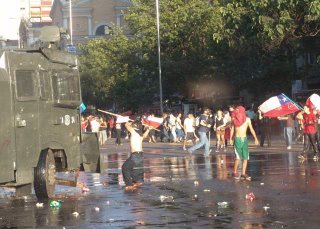
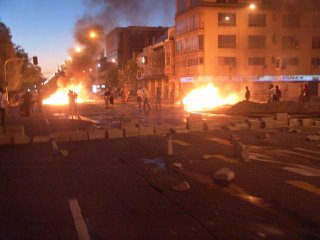
The news of the death of dictator Pinochet spread fast among circles throughout Latin America. I was in Sao Paulo at a film festival. As we heard the news, fellow political film makers embraced eachother with joy. As the meeting ended we brought opened bottles of beer and made a special toast: to the death of a dictator and for freedom. Traces of the dictatorship are alive and well in Chilean society. Currently Michelle Batchelet has ordered police forces to repress any street protests
that may interfere with the neoliberal order. Many activists have been put in jail in recent days, anarchists and mapuches fighting for self-determination. This short entry is dedicated to the some 4,000 Chileans who lost their lives fighting for a better world.


30 Years Since Chile's Military Coup, Allende Lives

Marie Trigona October 3, 2003

Long live Chile! Long live the people! Long live the workers!
These are my last words and I am certain that my sacrifice will not be in vain.
I am certain that at least it will be a moral example
that will punish the felony, cowardice, and treason."
-- Salvador Allende, Sept. 11, 1973

For Latin Americans, Sept. 11 marked a cataclysmic event well before that same date in 2001 was etched in the conscience of the U.S. populace by terror attacks on the Pentagon and World Trade Organization headquarters. On that date in 1973, Chile awoke to a U.S.-supported military coup against its democratically elected socialist president, Salvador Allende. By 12:15 p.m., Allende lay dead in La Moneda, Chile's presidential palace.

To commemorate the thirtieth anniversary of the attack, activists from across the continent gathered in what was more a celebration of the man and his government than a requiem. The International Seminar "At 30 years, Allende lives!" took a close look at the surge of grassroots organizing that grounded Chile's agrarian reforms, as well as struggles for housing and dignified employment during Allende's three years as president. Participants stressed the need for similar popular participation to increase democracy in today's Chile.

U.S. Involvement, End of People's Government

"The armed forces have acted with patriotic inspiration to take a nation out of chaos, a grave chaos that Allende's Marxist government caused," declared a triumphant Gen. Augusto Pinochet Ugarte the night of Sept. 11. Chile's military junta (1973-1990) replaced Allende's democratic socialism with a tyranny of terror that continues to haunt the nation.

Allende's government was targeted as a threat to U.S. strategic policy in Latin America early on. White House tapes reveal that on Sept. 14, 1970, then-President Richard Nixon ordered measures to force the Chilean economy into bankruptcy. "The U.S. will not accept a Marxist government just because of the irresponsibility of the Chilean people," declared Henry Kissinger, Nixon´s secretary of State. "The CIA had a large role in the strike against Salvador Allende and the Chilean people," states U.S. author James Cockroft. "Big corporations like [the] ITT American telecommunications giant also played a large role in preparing the conditions for the coup in Chile. Economic blockades, destabilization of the economy, direct military participation were all part of the imperialist intervention of the CIA and U.S. military," continues Cockroft.

Four U.S. battle ships approached Chile's coast Sept.11, supposedly to participate in regional military practices. They maintained permanent contact with the coup leaders. Leading up to the coup, in July and August right-wing terrorists trained by U.S intelligence agencies carried out over 250 sabotage actions, exploding electric lines, targeting industry belts, and assassinating key civilians. In October 1972 the Chilean Transport Confederation called a general strike, financed by the CIA, which paralyzed the nation. Months before the military coup, the Chilean army began immobilizing worker-controlled factories by organizing operatives and testing the possible reactions of the working class to a coup. "Three years of economic war permitted the White House and internal opposition to win an important sector of the middle class. It's here the official rebels found the base of support to develop their plans," expresses Patricio Guzmán in his moving film The Battle of Chile.

"Economic methods to destabilize progressive governments were perfected in 1973," comments Cockroft. Even while confronting attempts at destabilization, Allende's approval among public opinion rose. On Sept. 4, 1970 Allende, as candidate of the Popular Unity Front, was elected with 36.4% of votes. In March of 1973, Allende's party won legislative elections with 43. 4%. In response to employer lock-outs in industry, factories were nationalized and workers organized themselves to control production. Activists from MIR, the Leftist Revolutionary Movement, tell of expropriating buses with pistols in hand and working armed inside factories to guarantee that production and transportation continued.

Workers, peasants, students, and state workers rallied behind Allende in huge street demonstrations, by organizing community deposit centers where food was sold at cost, and by opening supermarkets closed during the business shut-down. On Sept. 4, 1973, in response to the perceived immanence of the coup attempt and a plebiscite planned for Sept. 11, the largest political act in Chile's history was held in Santiago's center, mobilizing tens of thousands of people.

Cockcroft notes that as a result of the coup, the Chilean oligarchy and the U.S. imperialists were able to install a repressive dictatorship and a neoliberal economic regime that left the majority of the people poorer than during Allende's government, when over half the population improved its economic condition. Pinochet immediately applied U.S.-prescribed measures of privatization and elimination of restrictions on the circulation of capital. Conditions favorable to foreign investors, including tax exemptions, and the lowering of environmental and labor standards sought to lure foreign investors.

But the neoliberal model imposed after Allende's fall was only possible through the brutal control of all political dissent, achieved by militarizing society and implementing a state of terror. "After Sept. 11 all military resources were used to repress the Popular Unity Front, with North American compliance and presence," Guzmán narrates. In the ensuing days, sport stadiums were transformed into concentration camps where thousands passed through the hands of the dictatorship's terror and torture; executions and disappearances became commonplace.

Over the next 17 years, Pinochet's dictatorship insured a submissive and dependent economy and a stranglehold on dissent. It is estimated that about 550 enterprises under public-sector control, including most of Chile's largest corporations, were privatized between 1974 and 1990. During the same period, some 3,000 people were officially declared dead or disappeared.

The Past that Lingers

"After 30 years, our history is still an open, bleeding wound," states Cesar Quirós, Chilean human rights activist from the Manuel Rodríguez Movement. He notes that Chile's transition to democracy has been full of contradictions. Until the late 80s Pinochet's regime maintained strong control. On Sept.11, 1980 Pinochet adopted a new Constitution to stay in power and announced a plebiscite for 1988. With civil society pressuring for elections, Pinochet's regime was rejected in the plebiscite. He remained in power until his executive term ended in 1990.

Pinochet and his supporters formed a political party, the Alliance for Chile. The first candidate of the right-wing alliance was Pinochet's former Minister of Finance Hernán Büchi Buc, who ran as an independent supported by the pro-government Independent Democratic Union (UDI, by its Spanish initials). Center-left forces formed a coalition made up of 17 parties to defeat the new right and it succeeded with the election of Christian Democrat Patricio Aylwin, with 55.2% of votes in December 1989. Today, the coalition includes the Christian Democrats and center-left politicians, among them many who supported the coup and participated in the Pinochet dictatorship.

Thirteen years have passed since the end of the dictatorship and the much-heralded "return to democracy," but many of the old systems of repression remain. Even now, people continue to denounce new cases of disappearances. Chile has not been able to solve past crimes and current contradictions that have permanent effects on today's society: Some 1,200 disappeared remain unaccounted for; impunity for war criminals continues to be the legal norm; the same military and police forces control the streets; and ex-military leaders of the dictatorship are serving as senators for life. Nelson Mery, chief of Chile's Investigative Police since 1990, resigned his post on Sept. 26 of this year, more than a month after being formally accused of torturing prisoners during the 1973-1990 dictatorship of Pinochet.

Quirós maintains that due to pressures from the right-wing and U.S. political interests, Chile's return to democracy has brought little fundamental change. "Chile's democracy is still a dictatorship, nearly intact. Constitutional powers are the same, it's the same Constitution of 1980. When you talk about Chile's armed forces, they are the same as under Pinochet. The armed forces continue to claim that they will not allow another popular government like Popular Unity. They've made sure that popular sectors are not able to embark on a new attempt to change this unjust society that excludes the majority and is anti-democratic."

The Chilean Constitution that Pinochet adopted provides the military with autonomy from civil government, allowing armed forces to act unchecked. Referring to the Constitution, current President Ricardo Lagos has stated: "The authoritarian seeds are there intact. Our transition has not been concluded, we don't have a Magna Carta that has democratic norms." Nonetheless, many feel that Lagos' efforts at political reform have been symbolic, while at the same time guaranteeing impunity and amnesty for those responsible for crimes during the dictatorship and dutifully applying neoliberal policies.

"For 30 years, Chile has been a model of imperialism. Now we have both forms, economic and military control. Economic measures today are the same neoliberalism that Pinochet implemented in the 1970s, but it's more ferocious, sophisticated and complete," Cockcroft asserts. He adds that today these policies are being imposed by free trade accords, exemplified by the North American Free Trade Agreement (NAFTA) in the north and the U.S.-Chile Free Trade Agreement in the south.

Although from the same party as Allende, Lagos has been a staunch promoter of the free trade agreement with the United States. In July, the U.S. Congress ratified the free trade Agreement with Chile and the Chilean Congress expects to pass and sign the agreement no later than Oct. 31. The first ratified free trade agreement of this type in South America will then take effect Jan. 1, 2004. The United States is already Chile's primary client for exports, with total sales to the United States at over $2.87 billion. The agreement with Washington will immediately lift 85% of Chile's import taxes and will totally abolish tariffs by 2014. Lagos had already signed a free trade agreement with the European Union in 2002.

Conflicts Unresolved

Chile has adopted a model for development that only benefits a small sector of society, led by transnational businesses, and leaving out most workers and peasants. Nearly 22% of the population is living below the poverty line and the unemployment rate stands at 9.2%. The economy has been globalized through privatizations and is dependent on imported capital and foreign investment. Conditions for macroeconomic policies are set by foreign bodies, especially the U.S. government and the multilateral financial institutions. Like its neighbors Argentina, Brazil, and Uruguay, Chile continues to borrow from financial institutions to stabilize capital flows, while private debt accumulated under the dictatorship has been absorbed by public sectors. In 1980, Chile's debt was $11.2 billion; by 2002 it had swelled to $40.4 billion.

Agrarian reform carried out under the Allende administration has become a thing of the past. On the contrary, tendencies toward concentration of land have grown stronger in recent years, a cause for concern in a nation where nearly 14% of the labor force works in agriculture. Francisca Ramírez, indigenous activist from Vía Campesina, sees the impact of the transnationalization of agriculture on the small farmers she works with every day. "We are demanding that what we produce and eat not be determined by corporations and capital forces. This government's vision is that agriculture has its basis in the free market, that it's necessary to produce for those with money." She reaffirms the need for Chile to be able to sustain its basic needs through developing agricultural diversity and blocking agri-corporations from further extending systems of monoculture.

The past two decades have also seen increasing conflict between Chile's indigenous peoples--particularly the country's largest indigenous group, the Mapuche--and a series of Chilean governments over questions of land rights and development. These conflicts have resulted in a number of deaths. Most recently a 17-year-old Mapuche activist, Edmundo Alex Lemun, died on Nov. 12, 2002, five days after being shot in the head during a clash with carabineros (police) who were trying to forcibly remove a group of Mapuches occupying ancestral indigenous lands claimed by the Mininco lumber company in Angol Province. There are dozens of Mapuche activists today being held as political prisoners in Chile's jails as part of struggles for land rights.

Washington's policy proclaims that the proposed free trade agreements will help usher in "a hemisphere of liberty." Linking free markets to democracy, U.S. President George W. Bush has declared that "people who operate in open economies eventually demand more open societies." The U.S. continues to support governments that adopt favorable conditions to foreign capital and investments, but today it chooses its tactics more carefully. Making back-door trade agreements, setting financial conditions, and controlling the poor through structural adjustment policies of international lending institutions have replaced financing and supporting military dictatorships.

All-Too-Living Legacy

On Sept. 11, while Lagos attended ceremonies in front of La Moneda to commemorate those who lost their lives 30 years ago, Pinochet attended a different ceremony. Twisting history to celebrate himself as a legitimate statesman, Pinochet commemorated 30 years since the military coup and donated his presidential sash to the Pinochet Foundation. This foundation's objective is to honor the dictatorship. Some 4,000 people attended this ceremony. In a symbolic act, current head of the Chilean military Gen. Juan Emilio Cheyre, made a surprise visit to Pinochet's home to chat with the ex-dictator--who was Cheyre's commander-in-chief in 1973. Neither made any public declaration of what they talked about in the meeting. Cheyre also attended ceremonies at the Military School to commemorate the deaths of anti-Allende forces during and after the military coup. In national newspaper headlines he was quoted as saying, "I feel secure about our power to manifest that the Chilean Army has carried out its tradition of military honor."

Jorge Martínez Busch, former military commander-in-chief and current senator, also publicly defended the military coup. In one of the ceremonies he stated that the military should "wake up and take action," referring to the military's power to guarantee immunity for crimes against humanity.

On Sept. 9, family members of the disappeared and ex-detainees peacefully occupied the Mexican, Portuguese, and Swiss embassies to demand an end to impunity for military criminals. "We have organized this action, because at 30 years since the military coup that ended Salvador Allende's constitutional government, the state has not sought justice for crimes against humanity, or executions perpetrated by the Armed Forces and agencies created to repress a defenseless population," stated a woman participating in the action. "In 13 years the government of conciliation has not reached truth and justice with respect to the atrocities committed by the dictatorship. There are more than 200 ex-military personnel exempt from judicial process, including Pinochet. Also exempt from justice are many civilians who investigated, collaborated, covered-up, or participated directly in repressive acts."

Days after the military coup, songwriter Victor Jara was detained, tortured, mutilated, and executed inside Chile's National Stadium. His body--badly beaten, with 44 bullet wounds and wrists broken by rifle butts--was found days later in an abandoned field. Thirteen years after Chile's transition to democracy, Lagos agreed to officially rename the stadium after Jara on Sept. 12. This symbolic gesture marks years of struggle by organizations and activists, but it also marks the contradictions between today's democracy and a system of terror still intact. The night of Sept. 11, hundreds participated in a march to the stadium to realize an act of homage to Victor Jara. As in like cases of so-called "unauthorized" marches, Chile's police force was ordered to repress. Demonstrators were tear-gassed, water-cannoned, and beaten. Four hundred arrived at the stadium, where thousands of candles were lit to give homage to those revolutionaries who died. Outside, hundreds more gathered after marching down the Alameda where they confronted the police.

During what the newspapers called "the night of terror," some 200,000 people in the working class neighborhoods outside of Santiago suffered a blackout when electricity lines were cut. Neighborhoods themselves cut the electricity to make it harder for the police to repress demonstrators. The worst battles between police and demonstrators were fought in these working class neighborhoods. After it was all over, police chief Alberto Cienfuegos sent a radio message congratulating the police for their work "with so much passion and energy." Twelve police officers were wounded in the actions, one shot in the face. There were some 300 demonstrators detained.

History, memory, and personal experiences have not let the events of Chile's past 30 years be erased. Activities and actions commemorating Allende demonstrate that thousands of Chile's workers, peasants, and students have not abandoned what is known as the "Battle of Chile." Chilean organizations and social movements continue to demand justice for the disappeared, an end to impunity, and a real democracy.

"I was here during Allende's government. I learned a lot from the Chilean people. It's important for the world to understand who this hero was. The other lesson to learn is that this president didn't prepare the people for such an attack, an attack so voracious. Many in the government knew that the coup was very probable. It's hard to say this publicly, but we recognize that we need to prepare ourselves to defend ourselves. Prepare ourselves against a military intervention," James Cockroft warned at the 30-year anniversary.


Blog Archive